Renfrew-Collingwood Community News

News stories from the Renfrew-Collingwood community in East Vancouver


Leave a comment

Battling the European chafer beetle

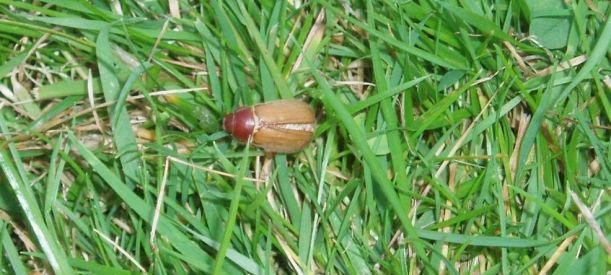
A chafer beetle in the back yard

A chafer beetle in the backyard. Photos by Julie Cheng

BY JULIE CHENG

Those pesky chafer beetles star started showing up earlier this year—from late May right til the end of June.

They first showed up coming from underground and creeping up strands of grass on the lawn, where I’d stomp on them, wincing at every loud crunch. Mid June found me outside with a broom whacking my tall rhododendron where they swarmed at dusk, hoping, I reasoned, to ruin their sex lives so they wouldn’t mate and lay eggs on my lawn. I later used the more dignified tactic of spraying them with the hose.

Late June I found some dead ones in my backyard. I imagined them burrowing down into the grass, laying their 300 eggs or so, then dying, their life spent but fulfilled.

Signs of chafer beetle

Chafer grubs

Chafer grubs can be found in lawns from fall to spring.

Adult European chafer beetles are copper-coloured beetles. Females lay eggs, which hatch in about two weeks and grow into grubs. These soft, white grubs chomp on the grass roots, destroying lawns.

My lawn will start showing damage from fall to early spring. During this time, the resident skunk and the crows make a buffet of them. I don’t mind these critters digging up the lawn, I think they’re doing me a favour by eating as many of the grubs as they can.

Otherwise, I’d be digging them up myself. I have been known to smash a few with my shovel out of frustration, but mostly I dig up 10-20 a day and feed them to my neighbour’s chickens. You have to love those yummy, protein-rich chafer eggs the chickens produce.

Fighting chafers naturally

It’s important to keep your lawn healthy. This means regular aerating, watering and mowing, as well as applying lime. Try overseeding your lawn with tall fescue grass, which the beetles don’t like to lay their eggs in and the grubs have a hard time feeding on. Microclover is also a good choice.

In the city of Vancouver, you’re not allowed to use pesticides to treat chafers, but you may use nematodes, which are microscopic worms that attack the grubs. You can buy nemadoes at a garden store.

Make sure you apply the nematodes early mornings or evenings or on a cloudy day and keep the soil moist for four to seven days afterwards. You may purchase a water exemption permit from the city to sprinkle your lawn extra days (http://vancouver.ca/home-property-development/water-exemption-permits.aspx).

For more information:

City of Vancouver http://vancouver.ca/home-property-development/chafer-beetles.aspx

Copyright (c) 2016 Renfrew-Collingwood Community News


Leave a comment

MP Don Davies takes Kingsway students to Ottawa

Create-Your-Canada

Don Davies, MP, with 2016 Create Your Canada winners Mabel Huang of Windermere Secondary School and Judy Gong of Gladstone Secondary School. Photo by Chelsea Charman

Two Vancouver Kingsway students, including one senior Windermere Leadership student, were the lucky recipients of an all-expense paid trip to Ottawa from June 12 to 14 to participate in Canada’s Parliament through the 2016 Create Your Canada contest, hosted by our local member of Parliament, Don Davies.

Started by Don Davies in 2009, this annual contest is open to all Vancouver Kingsway students taking Grade 11 or 12 classes.  Create Your Canada challenges students to propose ideas that they feel will make a better Canada or a better world.

The winning idea is submitted by Davies to Parliament where it is drafted into federal legislation in the form of a Private Members Bill. This year, the winning entry was jointly submitted by Mabel Huang from Windermere Secondary and Judy Gong from Gladstone Secondary.

Mabel is in Windermere’s Leadership program and has volunteered with a number of organizations including Youth Celebrate Canada Day and Windermere’s Climate Change Conference. She and Judy were selected for their proposal to introduce a national pharmacare strategy.

“We were inspired by the discussion of health care in my Law 12 class. We then researched and found out that of all the countries with a universal health-care system, Canada is the only country where prescription drugs aren’t covered,” said Mabel.

“We are looking for a feasible solution to give everyone an equal opportunity to access prescription drugs, since many citizens are not taking prescribed medications they need because they can’t afford it,” added Judy.

The winners were treated to a jam-packed two-day tour of Parliament Hill where they visited the House of Commons, Senate, Peace Tower, Library of Parliament, Sir John A. MacDonald’s office, and met many politicians from all parties. They also had time to visit the Supreme Court of Canada for a tour and the Canadian Museum of History in Gatineau, Quebec.

“This is a great way for youth to share their vision for our country,” said Davies. “I think it’s also an engaging and fun introduction to Parliament and the legislative process.”

Honourable mentions for the 2016 Create Your Canada Contest go to:

  • Robin Horner from Windermere Secondary School for her idea to create a national strategy for mental health services for youth.
  • Thien Ho from Sir Charles Tupper Secondary for his idea to create a national incentives program for the purchase or lease of electric and hybrid cars.

Don Davies funds the Create Your Canada program entirely by himself, and no taxpayer funds are used.

Copyright (c) 2016 Renfrew-Collingwood Community News

Leave a comment

Still Moon Arts takes youth on a caravan along the Fraser

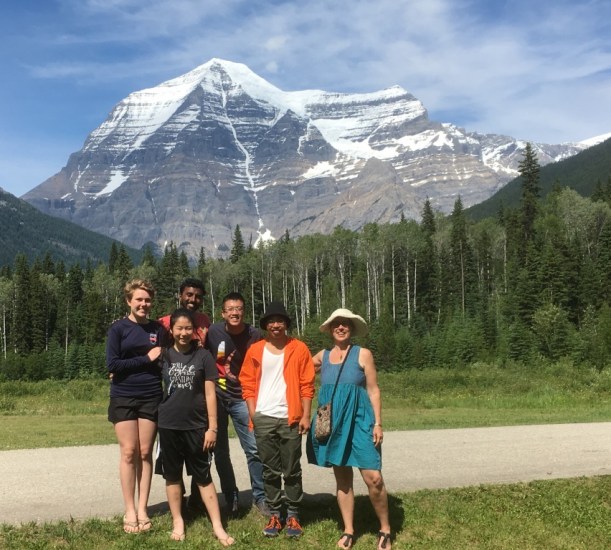
Carmen_team_Mount_Robson

The Still Moon Arts team started off at Mount Robson, the headwaters of the Fraser River. Photo courtesy of Still Moon Arts


BY LUCAS CHAN

Youth from the Still Moon Arts Society spent a week in June travelling along the Fraser River watershed in the 2nd annual Wild Salmon Caravan!

The Wild Salmon Caravan, taking place from June 6 to 11, was a journey from Mount Robson to Vancouver celebrating the spirit of the wild salmon through indigenous communities in Chase, Adams Lake, Kamloops, Lillooet, Lytton, Chilliwack and Abbotsford.

“The journey was really about celebrating, recognizing and honouring the spirit of the wild salmon, and how it is interconnected with First Nations culture as well as the rest of the environment,” said Henry Lau, one of the youth from the Still Moon Arts Youth Team.

The spirit of the salmon is something that influences across cultures and communities, representing more than just the ecological health of the land or water but also the relationships communities have with nature and each other.

Chitha_Lytton_Ceremony

It was an honour to take part in the Lytton ceremony. Photo by Chitha Manoranjan

Groups from across British Columbia joined the Wild Salmon Caravan in this travelling collective of culture, art, drumming, music and storytelling. It sought to connect with people and express the significance of salmon to the well-being of our cultures, communities, food systems and nature from an indigenous perspective.

“What I witnessed reminds me about how food is important to me in my neighborhood of Renfrew-Collingwood and how that is connected to the ways that First Nations groups access culturally relevant food in their own indigenous landscape,” said Crecien Bencio, who also participated in the journey.

The Wild Salmon Caravan also stressed the importance of building strong relationships with indigenous communities and conducting meaningful reconciliation processes. Threats of development and climate change endanger the well-being of the wild salmon that are so intricately linked with the land and its people. The Wild Salmon Caravan carried the wishes and hopes for what relationships with wild salmon was in the past, what it is in the present, and what will be in the future.

Still Moon’s previous youth engagement coordinator Chitha Manoranjan expressed, “I’m proud that we were able to take a small team of youth from this community up on this journey to share stories of our community’s successful efforts at bringing chum salmon back to Still Creek and bring some of Still Moon Arts’ creative energy. More importantly, it was an honour to be so warmly welcomed to different indigenous communities and be witness to the rich cultures and experiences that these communities have.“

The journey was part of Still Moon Arts’ Youth Engagement Project funded by the BC Arts Council. The youth team was made up of two Grade 9 students from the Leadership 9 Ecology class who have been working in the Renfrew Ravine this past year, and two long-time youth volunteers (and dedicated board members).

The team returns to the community with deeper knowledge, experiences and stories that are necessary to continue to act as stewards of the salmon and inspire the community to create their own intercultural experiences around food.

To find out more about Still Moon Arts Society’s journey on the Wild Salmon Caravan, visit www.stillmoon.org or find out more about the Wild Salmon Caravan at www.wildsalmoncaravan.wordpress.com.

Lucas Chan is a summer student with Still Moon Arts Society.

Copyright (c) 2016 Renfrew-Collingwood Community News