Renfrew-Collingwood Community News

News stories from the Renfrew-Collingwood community in East Vancouver


Leave a comment

Study Buddy Mentors needed for Big Sisters of BC Lower Mainland

Big-Sisters-Study-Buddy-Mentors

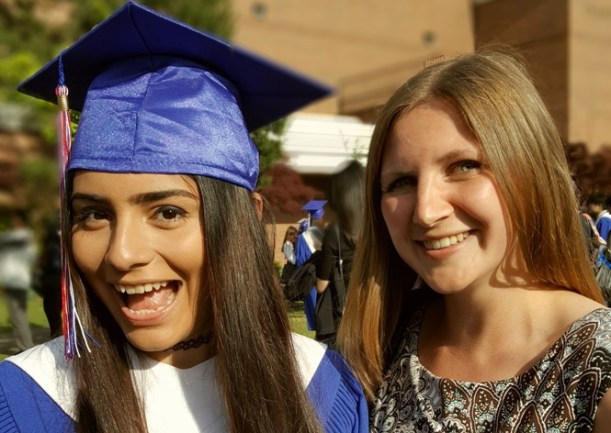
Big Sister Anna (right) attended Little Sister Olimpia’s high school graduation. The two were matched for four years and Olimpia credits her Big Sister for helping her attend post-secondary education. Photo courtesy of Big Sisters BCLM.

Big Sisters of BC Lower Mainland (Big Sisters BCLM) is in need of Study Buddy volunteers throughout the Lower Mainland, especially in Burnaby and the Tri-Cities.

The Study Buddy program is a weekly one-to-one mentoring relationship that focuses on school work. Little Sisters in this program not only improve their academics but also report a higher level of self-esteem. Take for instance, Study Buddy Anna and Little Sister Olimpia, who were matched when Olimpia was in Grade 9 and was, as she describes it, a “rebellious teenager.”

“I dropped bombs on Anna, testing her to see if she would stick around,” said Olimpia about their first year as a match. Anna stayed by her side.

“At the end of the day, Olimpia had self-perceptions that weren’t true,” said Anna. “Olimpia’s teachers and some of the other adults in her life were not supportive, viewing Olimpia as a problem kid on her way to dropping out of high school. But as I got to know her, she began to see otherwise.”

Now, Olimpia is in her first year at Langara College and is hoping to complete her degree in psychology or social work at the University of British Columbia.

“Without Anna’s influence in my life, I probably wouldn’t be going to college,” said Olimpia.

A study conducted by the Boston Consulting Group supports Olimpia’s statement, showing that adults who had a mentor as a child are more likely to volunteer, donate, complete post-secondary education and feel confident.

“Mentoring has a powerful impact,” said Brenda Gershkovitch, executive director of Big Sisters BCLM. “Research shows that students who meet regularly with their mentors are 52% less likely than their peers to skip a day of school and 37% less likely to skip a class. Plus, girls with a mentor are four times less likely than their peers to bully, fight, lie or lose their temper.”

In 2016, Big Sisters BCLM matched 775 girls in the Lower Mainland. There are currently 141 girls ready to be matched.

“We expect the number of Little Sister referrals to grow once school starts up in September,” said Gershkovitch. “Get your application in now, so we can give these girls positive mentors when they need it most.”

For more information on how to become a Study Buddy volunteer, visit www.bigsister.bc.ca/study-buddy.

Copyright (c) 2017 Renfrew-Collingwood Community News


Leave a comment

Common Voices: The Cultural Legacy of Italian and Cantonese Opera in Vancouver

Exhibit at Italian Cultural Centre’s Il Museo runs until July 15

Chinese-Opera-Common-Voices

Rosa Cheng, Vancouver Cantonese Opera, 2016. Photos courtesy of the Italian Cultural Centre

BY ANGELA CLARKE

Spanning May and June, which are Asian and Italian heritage months, the Italian Cultural Centre mounted an exhibition on the history of Cantonese and Italian opera in Vancouver. While these two art forms evolved independently from two diverse musical traditions, they share significant commonalities as major performance genres spanning the cultural history of the Chinese and Italian communities in Vancouver.

Both art forms have been practised in Vancouver since the beginning of immigration to this area, around 1885. They are known for their elaborate costuming and make-up, as well as the immense skill required of the artists who devote their lives to interpreting these musical genres.

While both musical forms are viewed as an acquired taste, often requiring some knowledge of the music and its history before they can be appreciated, historically, they have contributed significantly over the last century to the cultural landscape of Vancouver. Both genres have enabled both the Chinese and Italian communities to remain connected with their cultures of origin as they have negotiated their way in their new home of Canada.

Art, opera and cultural discrimination

Vancouver-Opera-Common-Voices

Vancouver Opera, Norma, starring Joan Sutherland, 1963.

The story of Italian and Cantonese opera also tells the story of discrimination and isolation. For both Italian and Cantonese communities in Vancouver these musical genres were often performed as a means to create community and connection in times of duress.

The exhibition tells the story of the Italian men interned in the work camps of Kananaskis in Alberta and Petawawa in Ontario, who created a camp choir of internees. These men, surrounded by armed guards, travelled around the countryside performing scheduled appearances. Despite being under heavy surveillance they were in demand among the civilian communities around Petawawa. There was even a professional opera singer, Piero Orsatti, among them.

For the Cantonese-speaking men living in Vancouver’s Chinatown, Cantonese opera and its performance was a means to create a haven for men who could not speak English, and due to the laws of exclusion, where banned from bringing family to Canada. Cantonese opera was a means of creating a foundation of familiarity in an unfamiliar and hostile environment.

For the Chinese men who immigrated to Vancouver for work on the railway, Cantonese opera was compelling not only because of the language but also for the many female performers who travelled from China in theatrical troupes. Certainly the story of Cantonese opera in Vancouver is an important and unique vignette offering scholars important insight into the history of women in Vancouver performance history. Women performers drew large audiences in Vancouver in the 1920s and ’30s, a full decade before women were even allowed to perform in their native China. As well, despite the traditionalism of the art form, these female artists, performing along the West Coast of the United States and Canada, became renowned for their alluring sense of style and the adoption of North American silver-screen aesthetics.

Currently Cantonese opera in Vancouver still continues to be relevant largely due to the female performers. In the Chinese community, women train as interpreters of this genre later in life, desiring to reconnect with their culture in retirement. Women train to interpret both the male and female roles.

Today Italian opera continues to emerge from its Eurocentric origins, finding contemporary relevance in plot lines located in post-colonial environments. As part of the repertoire for the Push Festival in 2017, Third World Bunfight produced a modern retelling of Verdi’s opera Macbeth. This full-length opera relocated the traditional plotline from medieval Scotland and placed it into the current political realities of the Congo in territories governed by military dictatorships. This production was supported by Vancouver Opera and the Italian Cultural Centre.

This exhibition on the history of Cantonese and Italian opera in Vancouver features historic costuming and interactive video to animate this story. The exhibition runs until Saturday, July 15, 2017.

Angela Clarke is the museum director and curator at the Italian Cultural Centre Museum. The Common Voices exhibit has been supported by Canada Heritage, the Museum of Migration and the Italian Cultural Centre.

Copyright (c) 2017 Renfrew-Collingwood Community News