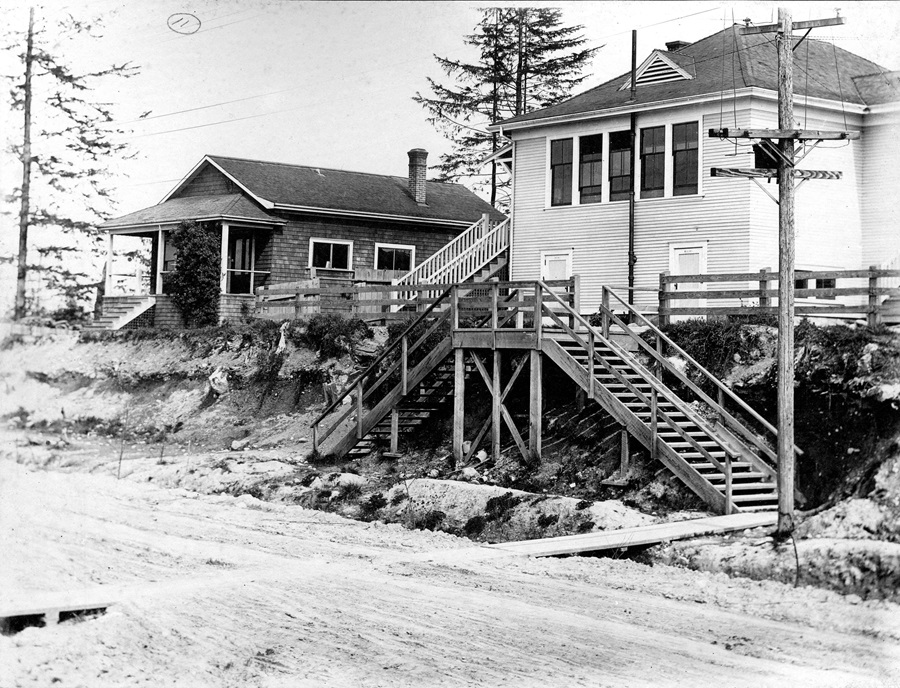
Connaught School, December 20, 1913. Source: Greater Vancouver Chinook newspaper, UBC Library
While browsing the Greater Vancouver Chinook newspapers online at the UBC library website, I discovered a photo in the 1913 edition showing Connaught School, which confirmed my previous research. The school was renamed John Norquay Annex (1933–1955) before changing to Sir Wilfred Grenfell School (opened in 1958). Grenfell school is still in operation as of 2024 at 3323 Wellington Avenue.
I wrote about this in detail in the November 2019 issue of the Renfrew-Collingwood Community News.
Rupert Street School on Bayley’s Claim, incorrectly named. Source: Vancouver Archives, 1910s.
In the Vancouver archive photos, the school is incorrectly named Rupert School. The description should read Connaught School, as confirmed in the BC Directories and other sources.
I had no real proof that these photos were of Connaught School until now. The UBC library website is free to use and has a wealth of information about the past. Please use this free resource to explore Collingwood history for yourself.
Dr. Angie Choi is a doctor of traditional Chinese medicine and acupuncturist.
Unlike traditional medications that treat symptoms, acupuncture aims to restore your body’s balance, addressing the root cause of your allergies.
Seasonal allergies, also known as allergic rhinitis or hay fever, affect millions of people worldwide. These allergies are triggered by an immune system response to airborne substances that appear during certain seasons of the year.
Causes of seasonal allergies
Seasonal allergies are primarily caused by pollen from trees, grasses and weeds, which release these tiny particles into the air to fertilize other plants. When someone with a sensitive immune system inhales this pollen, their body mistakenly identifies it as a harmful invader and releases chemicals like histamine into the bloodstream, causing allergy symptoms.
The timing and severity of these allergies can vary significantly depending on climate, geographic location and what types of vegetation are prevalent.
For example:
Spring is typically marked by tree pollen, starting as early as February in certain regions.
During summer, grass pollen is prevalent, peaking in late spring and early summer.
In the fall, weed pollen, especially from ragweed, begins around August and continues until the first frost.
Symptoms
Common indicators of seasonal allergies include:
Nasal congestion and a runny nose
Sneezing
Itchy, watery eyes
Throat discomfort
Coughing
Dark circles under the eyes, known as “allergic shiners”
Fatigue, often caused by disrupted sleep due to other symptoms
These symptoms can vary from mild to severe and can greatly affect everyday life and productivity.
Treatments
Managing seasonal allergies typically involves a mix of preventative measures and medication. This includes staying indoors when pollen counts are high, especially on dry, windy days, using air purifiers, keeping windows shut during peak pollen times and minimizing exposure to dust and other allergens. Avoidance may extend to certain foods that could exacerbate allergies.
A holistic approach
For those looking for more natural ways to manage seasonal allergies, several holistic methods may complement or replace traditional treatments:
Acupuncture: This can help alleviate allergic rhinitis symptoms and boost your immune system.
Herbal remedies: Various herbs and traditional Chinese medicinal practices can provide symptom relief.
Dietary adjustments: Increasing water intake and consuming more foods high in omega-3 fatty acids, vitamin C and quercetin can help reduce inflammation and strengthen the immune system.
Nasal irrigation: Flushing the nasal passages with saline can help clear allergens and irritants.
It’s important for individuals to work closely with health-care providers to develop an effective allergy management plan that considers personal health history and the severity of symptoms. The goal is to reduce discomfort and prevent seasonal allergies from detracting from one’s quality of life.
Stay healthy and breathe easy!
Dr. Angie Choi is a registered doctor of traditional Chinese medicine and acupuncturist. dr.angiechoi@gmail.com
Time to get out and about in the spring sun. Take in the latest issue of the Renfrew-Collingwood Community News to find out all the great things happening in the neighbourhood.
Beaver and Dodge Lodge art installation by Still Moon Arts
They, They, & It: Reflections on Trans Identity – new exhibit at the Italian Cultural Centre until July 5
Collingwood Corner: Connaught School, now Sir Wilfred Grenfell
Consider acupuncture for seasonal allergies
Crow’s Nest – free little art gallery on the edge of Renfrew Ravine
Read On! Victoria and Victoria Day
Grandview-Collingwood Branch 179 legion updates
Do you have a local story to tell or an event to share? We’d love to hear about it! Email rccnews-editorial@cnh.bc.ca.
The deadline for the June 2024 issue is May 10.
We welcome story submissions from 300 to 400 words long. Accompanying photos must be high resolution in a jpg file at least 1 MB large and include a photo caption and the name of the photographer.




 Renfrew-Collingwood Community News