Renfrew-Collingwood Community News

News stories from the Renfrew-Collingwood community in East Vancouver


1 Comment

Indigenous art project at Windermere high school: Reconciliation from the ground up

BY JULIE CHENG

Windermere-aboriginal-art-Jerry-Whitehead

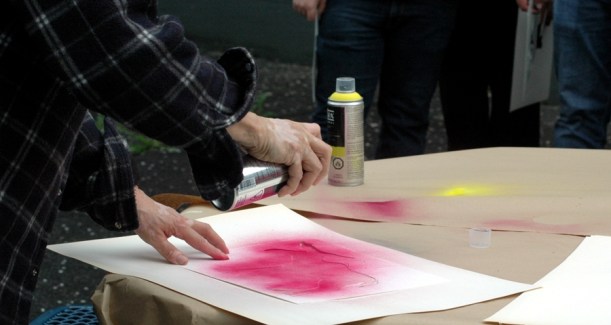
Aboriginal artist Jerry Whitehead demonstrates the art of spray painting. Photos taken and edited by Olivia Lee-Chun, Harkarn Kaler and Tiffany Tu

This spring, look for a new mural at Windermere Secondary School that brings together nature and Indigenous culture. Windermere has received a $20,000 grant from the Betty Wellborn Artistic Legacies Foundation for an art project that features local Indigenous artists running workshops and working with students to paint this mural.

Fine arts teacher Alyssa Reid’s project proposal was inspired from reading Wab Kinew’s The Reason You Walk, a memoir about reconciliation and healing between father and son that may ultimately spark conversation about Canada’s own reconciliation with Indigenous peoples.

Coincidentally, Windermere’s former vice-principal, Alison Ogden, had once posted outside her office a quote from the same book that Reid “really took to heart.”

The quote reads: “Reconciliation is not something realized on a grand level, something that happens when a prime minister and a national chief shake hands. It takes place at a much more individual level. Reconciliation is realized when two people come together and understand that what they share unites them and that what is different between them needs to be respected.”

Windermere-aboriginal-art

Two students spray painting the stencil design they created.

Windermere’s aboriginal support teacher, Davita Marsden, suggested to Reid that local contemporary Indigenous artists Sharifah Marsden, Corey Bulpitt and Jerry Whitehead might be interested in working on the project.

“After speaking with the artists we decided on three workshops for staff and students that would give them some grounding and knowledge in Indigenous art that would lead to a large (1,000 square foot) mural on the front of the school,” Reid explains in an email.

“Our basis for the mural is a rooting in Mother Nature that links everyone to the earth and stresses the importance of nature and the earth to our Indigenous people done in the three very unique styles of each artist.”

The workshops started late April, with Sharifah Marsden teaching a beading workshop, Corey Bulpitt doing a stencilling and spray painting workshop, and Jerry Whitehead leading a design question/answer workshop. The painting begins in May.

Julie Cheng is the editor of the Renfrew-Collingwood Community News.

Copyright (c) 2017 Renfrew-Collingwood Community News


Leave a comment

Adult education time machine: The history of the bookmobile in Renfrew-Collingwood

BY JOHN MENDOZA

Collingwood Bookmobile

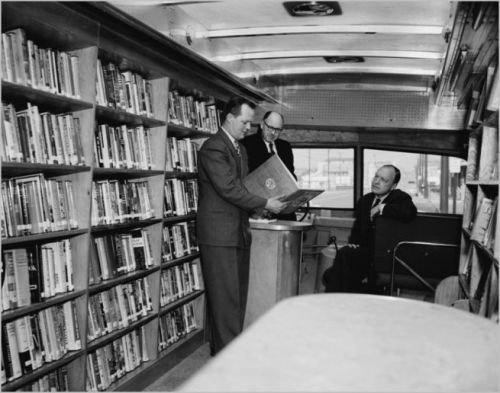
Interior of Vancouver Public Library Bookmobile with Harry M. Boyce, Peter Grossman, and Colin Robertson, 1953, Photographer: Province Newspaper. Photo from the Special Collections Historical Collections at the Vancouver Public Library, VPL Accession Number 3403

Much has been written about the architectural importance of the Vancouver Public Library’s Collingwood Branch Library here in Renfrew-Collingwood. Its modernist architectural design was so striking that, at one time, it was the most visited modernist building in all of Vancouver.

In turn, the design won the local architectural partnership of the commission to design the award-winning main library branch once housed at the corner of Burrard and Robson Street in downtown Vancouver.

However, a lesser but equally important story is the fact that Collingwood Branch Library was once home to Vancouver Public Library’s bookmobile. When there were far fewer branch libraries in Vancouver, a proposal for a bookmobile was mentioned in the Vancouver Public Library’s 1950 annual report.

By March 1956, the bookmobile was up and running, and quite popular with library patrons. According to an old newspaper article from the Vancouver Herald from July 19, 1956, the total circulation of library materials in the bookmobile’s first four months of operation was approximately 45,000 – a number equal to a small branch library.

The Vancouver Public Library’s humble Collingwood library was connected to the bookmobile as the branch library was headquarters for the bookmobile and its book supply. The book stock on the bookmobile was approximately 2,000 books. However, the bookmobile could pull from its inventory of 18,000 books from its storage area at Collingwood library.

From its humble home in Renfrew-Collingwood, the bookmobile once operated five days a week and initially had a dozen weekly stops all over the city. According to a 1960 annual report from the Vancouver Public Library, consistently popular bookmobile stops included Kingsway and Fraser, 25th Avenue and Main Street, 54th Avenue and Elliot, 54th Avenue and Victoria and Commercial and Broadway.

This little book bus operated by the Vancouver Public Library could definitely be categorized as an important agent in the development of informal adult education here in Vancouver.

An article in the Province newspaper from April 4, 1972, chronicled that the Vancouver Public Library even began as the “ ‘New London Mechanics Institute,’ a recreation room and library for employees of Hastings Mill at the foot of Dunlevy” when education and learning was at a premium. Many of these mechanics institutes were the predecessors of more formal institutions of adult education.

Furthermore, a Vancouver Public Library annual report from 1956 revealed that “wheels have brought the Vancouver Public Library to thousands of people who do not have the advantage of branch library service nearby” and its success encouraged the bookmobile’s librarian to say that the city needed more branch libraries.

According to an existing article written by Nora Schubert, the bookmobile’s route ran past several seniors’ homes, reaching an audience that otherwise may have gone without library service.

The bookmobile may have had humble roots, but it was an agent of transformation for both informal adult learning in the city and for the evolution of the city’s library system.

Local resident and writer John Mendoza uncovered this Renfrew-Collingwood connection while looking at the history of adult education in Vancouver. This article was originally written as an assignment for the University of BC.

Copyright (c) 2017 Renfrew-Collingwood Community News


Leave a comment

Adult education time machine: Witnessing adult education in the photos of the City of Vancouver Archives

BY JOHN MENDOZA

Originally written as an assignment for the University of BC, local resident and writer John Mendoza looks at the history of adult education in Vancouver and uncovers some East Vancouver connections.

Adult Education - Ladies driving

Ladies at driving education display in PNE B.C. building, 1954, photographer unknown, City of Vancouver Archives website

My assignment for a course in adult education at the University of British Columbia was to find photos that speak of adult education in a historical and contemporary setting. In finding photos, I wanted this challenge shaped by the desire to find something in the local community.

What would be in the City of Vancouver’s Archives that could articulate something about adult education? It was not an easy task to sift through numerous historical images, but slowly, four photos emerged. Of those four photos, two photos had definite links to the east side of Vancouver, specifically the Pacific National Exhibition.

Of the four photos, the two photos of adult learning opportunities captured after 1950 may seem unremarkable, but upon closer examination, reveal something far more complex. Both photos were created in the 1950s with only a one-year difference between them, and the name of the photographers are unknown.

Both photos were taken at the Pacific National Exhibition, affectionately known as the PNE. The PNE is an annual agricultural fair hosted at the Hastings Park site in East Vancouver, drawing both a rural audience from rural British Columbia and beyond, and an urban audience from the Lower Mainland. However, both photographic images forward the definitions of what adult education could be.

Both photos from the 1950s feature educational displays, where fairgoers could interact with the content any way they want. Also significant was the use of an agricultural fair as a place where learning could take place, transforming a popular attraction into “an agency of progress.” The driving display photo from 1954 was certainly timely; the end of the Second World War had ushered not only an emerging automobile culture, but also expanding opportunities for women.

Adult Education Totem Pole

Crowd watching Kwakiutl (Kwakwaka’wakw) carver Ellen Neel working on a totem pole, 1953, photographer unknown, City of Vancouver Archives website

Most fascinating is the 1953 photo featuring Kwakwaka’wakw (Kwakiutl) artist Ellen Neel, the first female totem pole carver from the Northwest Coast. Here we have a woman from a First Nations background demonstrating a centuries old skill (once largely dominated by male artists) in front of a diverse audience. Both these photos from the 1950s show that learning could occur anywhere, even in a humble agricultural exhibition setting.
Adult Education painting signs

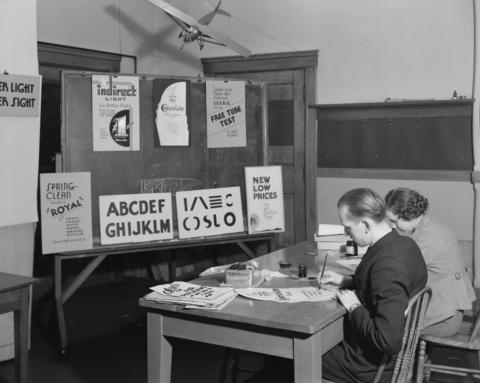
Man and woman painting signs, likely attending School Board Night Classes, circa 1937, photograph by Stuart Thompson (1881-1960), City of Vancouver Archives website

The two other photos that I found speak of adult education in Vancouver before 1950.

The photos share some common characteristics. Both photos happen to be taken by photographer Stuart Thompson in 1937 as part of a series about the formal adult education sector. The two photos certainly reflected the realization that specialized labour was eclipsing unskilled, general labour. While both photos feature male students, one photo is especially telling with one female student featured in the sign painting class. It is a pertinent detail as the mindset concerning women and formal education had changed significantly since the end of the First World War.

Furthermore, that photo is significant in that women were not only choosing to pursue adult learning opportunities, but opportunities that might have been perceived as belonging to a masculine domain. Yet another way that the power differentials in the formal adult education class were changing is what is missing in both photos, and that is the instructor.
Adult Education Headphones

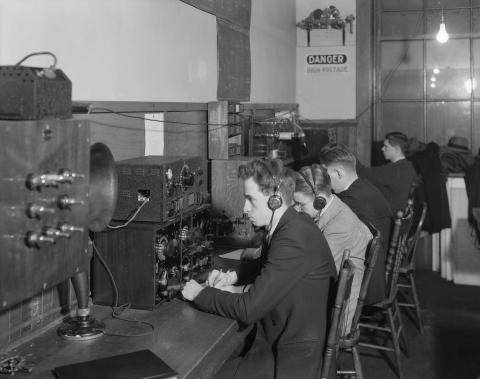
Men in Headphones Learning Technical Skills, circa 1937, photograph by Stuart Thompson (1881-1960), City of Vancouver Archives website

The authority of the teacher had been supplemented by the bulky presence of the radios and the sign painting models and templates featured respectively in each photo. Learning was going beyond “chalk and talk,” and placing the learner’s experience at the centre.

What’s poignant about the photos is the skills featured prominently within them – radio operation, sign painting – have been largely relegated to history as newer technologies have replaced them.

The photos do not offer a complete chronicle of Vancouver’s adult education history – certain stories and diverse communities are missing in its representation. But the few photos do offer a modern path of an adult education culture pushing through the walls of the formal classroom and out into the larger community.

Copyright (c) 2017 Renfrew-Collingwood Community News