Judith Praying in the Desert. Image courtesy of Il Museo and Lilian Broca
On November 12, 2015 at Il Museo in the Italian Cultural Centre, the contemporary artist Lilian Broca unveiled her new mosaic series Heroine of a Thousand Pieces: The Judith Mosaics of Lilian Broca.
While the artistic genre of mosaic is an ancient art form, it is ultimately modern, even post-modern. Like a computer screen that relies upon diverse pixels to create an image, the image of the mosaic is based on a combination of small light reflecting coloured fragments. When organized and arranged by a skilled artist, these fragments of glass can not only create a complete picture, they can also recount an entire story.
In this mosaic series, Broca has masterfully arranged thousands of coloured glass tesserae to tell the story of Judith, a heroine from the ancient text of the Biblical Apocrypha.
Broca’s work brings to the attention of modern audiences the story of an ancient heroine who is as complex as she is contemporary. Traditionally, Judith has been represented by Renaissance artists such as Caravaggio, Botticelli, Orazio Gentileschi and his equally famous daughter, Artemisia Gentileschi Judith, as a seductive and violent woman who is a threat to the social order.
However, in pursuit of this depiction important elements in the Judith tale have been overlooked and Judith has been much misunderstood. For this reason Lilian Broca has revisited the Judith story in its entirety. From her more detailed examination, Judith is not simply a problematic woman, a virago, but a courageous and devout leader who single-handedly saves her community.
By depicting this heroine and her complete story, constructed from thousands of pieces of Venetian glass, Broca reveals a figure wholly modern in character. As such, Judith remains an archetypal figure who continues to fascinate and inspire. It is Broca’s new vision of Judith that makes her not only a heroine of the past, but also for the 21st century.
Angela Clarke, PhD, is the curator of Il Museo at the Italian Cultural Centre. The exhibition Heroine of a Thousand Pieces: The Judith Mosaics of Lilian Broca runs until March 31, 2016. Museum hours are 10 am to 5 pm Tuesday through Saturday.
Copyright (c) 2015 Renfrew-Collingwood Community News
From VIVO’s poster collection exhibition, Videographics, curated by Paul Wong. Photo: VIVO Media Arts Centre
VIVO Media Arts Centre is one of Canada’s leading artist-run centres dedicated to the exploration, creation and dissemination of media arts. Since moving to Renfrew-Collingwood a year ago it’s become an integral part of our cultural community. In addition to its educational programs, artist-in-residence series, production support services and regular media art programming, it has brought some of Vancouver’s most innovative cultural events to the neighbourhood, including the International Symposium of Electronic Arts, LIVE Biennale of Performance Art and Vancouver New Music Festival.
What you may not know is that VIVO is also home of the Crista Dahl Media Library & Archive (CDMLA) – Western Canada’s largest collection of media art and independently produced documentaries. Its collection dates back to 1968 when Vancouver artists first got their hands on Sony’s revolutionary portable video recorders. The collection includes more than 6,000 video titles in addition to publications, documents, photographs, film and almost five decades of video technology.
Whether originally recorded on open-reel videotape or the latest digital technologies, the CDMLA makes rare works accessible to academics, curators, historians and the public through in-house research and curated exhibitions and events. There are several in the coming months you should check out.
Inside VIVO’s video archive. The display monitor was part of an exhibit by On Main Gallery entitled The Long Time: 21st Century Art of Steele + Tomczak. Photo: On Main Gallery
From November 22 to 28, VIVO joins grunt gallery and Western Front in presenting the inaugural Vancouver Independent Archives Week, a diverse series of free public events illustrating the unique value of artist-based archives and the vibrant history they contain.
VIVO’s exhibition will provide an overview of the archive’s history, highlight recent creative research projects, and immerse visitors in new media art incorporating or working with archival material including sound pieces, experimental video and installations. It will also feature an evening screening of newly digitized video by Gayblevision, Canada’s first TV series produced by and for the LGBT community. This historic series documents the people, places, events and ideas that defined Vancouver’s LGBT scene in the 1980s. Gayblevision alumni will be in attendance.
December features two events. On Wednesday, December 2, Vancouver’s first feminist film and video production centre, Women in Focus, will be featured at CDMLA’s popular annual dinner fundraiser, EATa: Evening at the Archive. This intimate and interactive series invites guests to view materials unique to the archive around a specific theme and to engage in a collegial conversation with the artists and others who were critical players in that historical moment.
On Friday, December 4, the volume is raised as local punk legends donate their talent for a one-of-a-kind musical extravaganza in aid of the collection of artist, provocateur and punk videographer, Lenore Herb.
VIVO Media Arts Centre is located at 2625 Kaslo Street. For information on all VIVO programs visit their website at www.vivomediaarts.com or their Facebook page. Want to know more about the events above or the Crista Dahl Media Library & Archive? Email library@vivomediaarts.com.
Copyright (c) 2015 Renfrew-Collingwood Community News
The joys and sorrows of immigration as an important source for artistic creativity
BY ANGELA CLARKE, PhD
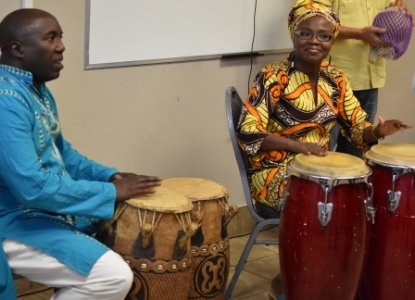
The artists who took the stage at the Italian Cultural Centre were Performigrators (or immigrant performers) in the truest sense of the word. Photo by Mark Evans
The Italian Cultural Centre and Collingwood Neighbourhood House closed the Vancouver leg of the European Union Project called Performigrations with a concert at the Italian Cultural Centre on September 13, 2015.
Through dance, spoken-work performance and originally composed Latin-themed music, the concert brought clarity to the theme of a three-week long project, entitled Performigrations: The People Are the Territory, that was initiated by the University of Bologna and its eight partner cities (Toronto, Vancouver, Montreal, Lisbon, Valletta, Klagenfurt, Athens and Bologna itself).
The exhibit of the same name continues at the Italian Cultural Centre’s Il Museo until October 30, 2015.
This international project looked at each immigrant as fundamentally a performer or creator, for, like an artist, each immigrant must confront a blank page or canvas when they come to a new country.
From the void of the unknown their lives must be recreated. This process of creation merges their past experiences and knowledge from the old country with new ideas and concepts derived from enforced adaptation to the new. Necessity breeds invention and the need of leaving the old country, oftentimes for financial or political reasons, forces the immigrant to create a new life from the unknown.
During the concert, the five artists who took the stage at the Italian Cultural Centre were Performigrators (or immigrant performers) in the truest sense of the word. Each artist applied their artistic knowledge from their old country to their creative process that they continue to undertake in their new home.
The concert itself reflected the spirit of contemporary immigration and cultural diversity in a unique and interesting way. Not only did performers from diverse cultural backgrounds and artistic mediums take the same stage during the two-hour long concert in a seamless flow, but it was a significant demonstration of the way immigration can lead to important artist collaborations.
Events such as this demonstrate that multicultural artists are not working in isolation, creating art and music for their own immigrant groups. Rather, these contemporary immigrant artists embrace, accept and welcome the artistic input of those outside their cultural perimeters. For example, the Afro-Cuban drummer Israel Berriel played for both Nigerian dancer Maobong Oku and Nicaraguan musician Ramon Flores.
In the case of the Japanese artist Yoko Tomita and spoken word artist Jillian Christmas, their collective experiences brought up important questions about immigration and familial memory, especially with regard to its monumental impact on personal identity.
Jillian’s work grapples with the powerful ability ancestry stories have to shape the memories of the young. To hear a story, she tells us, is to create a memory. When we hear someone’s story we absorb the teller’s experiences and the traumatic emotions encoded within it.
Yoko Tomita confirmed this but also added that, in some cases, such as her father’s experiences during the bombing of Hiroshima, very little needed to be told. Rather, it was her father’s reluctance to tell his story that formed her own traumatic relationship to the destroyed city.
Finally, Babette Santos closed the event with an uplifting thought. Immigrations stories, she reminded the audience, often contain great romantic gestures. To begin with the process of immigration is an adventure as one enters a new life, with new opportunities. Often these stories attest to the strong emotional bonds between husbands and wives who immigrate together or young couples who write compelling letters of great affection during periods of geographic separation. It is these stories, Babette notes, which will be the inspiration for her future work.
The five performers offered insight into the joys and sorrows of immigration and why it is such an important source for artistic creativity.
The Italian Cultural Centre would like to thank Andrea Berneckas, Yoko Tomita and January Wolodarsky for their generous collaboration.
Angela Clarke, PhD, is the curator at Il Museo, the museum at the Italian Cultural Centre, located at 3075 Slocan Street on Grandview Highway.
Performigrations, the exhibit, continues at Il Museo until October 30, 2015.
Copyright (c) 2015 Renfrew-Collingwood Community News


 Renfrew-Collingwood Community News