Renfrew-Collingwood Community News

News stories from the Renfrew-Collingwood community in East Vancouver


Leave a comment

Performigrations: Exhibit of immigration stories continues at Il Museo Italian Cultural Centre til Oct. 30

The joys and sorrows of immigration as an important source for artistic creativity

BY ANGELA CLARKE, PhD
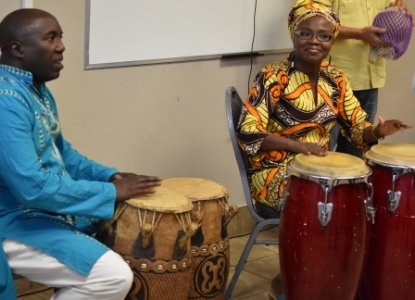
Performigrations Exhibit at Il Museo

The artists who took the stage at the Italian Cultural Centre were Performigrators (or immigrant performers) in the truest sense of the word. Photo by Mark Evans

The Italian Cultural Centre and Collingwood Neighbourhood House closed the Vancouver leg of the European Union Project called Performigrations with a concert at the Italian Cultural Centre on September 13, 2015.

Through dance, spoken-work performance and originally composed Latin-themed music, the concert brought clarity to the theme of a three-week long project, entitled Performigrations: The People Are the Territory, that was initiated by the University of Bologna and its eight partner cities (Toronto, Vancouver, Montreal, Lisbon, Valletta, Klagenfurt, Athens and Bologna itself).

The exhibit of the same name continues at the Italian Cultural Centre’s Il Museo until October 30, 2015.

This international project looked at each immigrant as fundamentally a performer or creator, for, like an artist, each immigrant must confront a blank page or canvas when they come to a new country.

From the void of the unknown their lives must be recreated. This process of creation merges their past experiences and knowledge from the old country with new ideas and concepts derived from enforced adaptation to the new. Necessity breeds invention and the need of leaving the old country, oftentimes for financial or political reasons, forces the immigrant to create a new life from the unknown.

During the concert, the five artists who took the stage at the Italian Cultural Centre were Performigrators (or immigrant performers) in the truest sense of the word. Each artist applied their artistic knowledge from their old country to their creative process that they continue to undertake in their new home.

The concert itself reflected the spirit of contemporary immigration and cultural diversity in a unique and interesting way. Not only did performers from diverse cultural backgrounds and artistic mediums take the same stage during the two-hour long concert in a seamless flow, but it was a significant demonstration of the way immigration can lead to important artist collaborations.

Events such as this demonstrate that multicultural artists are not working in isolation, creating art and music for their own immigrant groups. Rather, these contemporary immigrant artists embrace, accept and welcome the artistic input of those outside their cultural perimeters. For example, the Afro-Cuban drummer Israel Berriel played for both Nigerian dancer Maobong Oku and Nicaraguan musician Ramon Flores.

In the case of the Japanese artist Yoko Tomita and spoken word artist Jillian Christmas, their collective experiences brought up important questions about immigration and familial memory, especially with regard to its monumental impact on personal identity.

Jillian’s work grapples with the powerful ability ancestry stories have to shape the memories of the young. To hear a story, she tells us, is to create a memory. When we hear someone’s story we absorb the teller’s experiences and the traumatic emotions encoded within it.

Yoko Tomita confirmed this but also added that, in some cases, such as her father’s experiences during the bombing of Hiroshima, very little needed to be told. Rather, it was her father’s reluctance to tell his story that formed her own traumatic relationship to the destroyed city.

Finally, Babette Santos closed the event with an uplifting thought. Immigrations stories, she reminded the audience, often contain great romantic gestures. To begin with the process of immigration is an adventure as one enters a new life, with new opportunities. Often these stories attest to the strong emotional bonds between husbands and wives who immigrate together or young couples who write compelling letters of great affection during periods of geographic separation. It is these stories, Babette notes, which will be the inspiration for her future work.

The five performers offered insight into the joys and sorrows of immigration and why it is such an important source for artistic creativity.

The Italian Cultural Centre would like to thank Andrea Berneckas, Yoko Tomita and January Wolodarsky for their generous collaboration.

Angela Clarke, PhD, is the curator at Il Museo, the museum at the Italian Cultural Centre, located at 3075 Slocan Street on Grandview Highway.

Performigrations, the exhibit, continues at Il Museo until October 30, 2015.

Copyright (c) 2015 Renfrew-Collingwood Community News

Leave a comment

Meet Diana! An INTERactive connector

BY MELISSA CHAN

Diana, an INTERactive connector

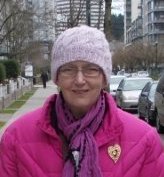
INTERactive connector Diana. Photo by Brenda Zeimer

Through my own volunteer work with INTERactive, I’ve met some inspirational, dedicated individuals in the Renfrew-Collingwood community—people who want to make a difference in the lives of others.

Fortunately, I was able to meet with Di (Diana) Dyck: A lady who puts a tonne of effort into her volunteer work, despite challenges she faces due to a disability. But that doesn’t stop her. What caught my attention was the fact that Di was even able to communicate with another person who does not speak her language.

Di has lived in Renfrew-Collingwood for several years and has been an INTERactive connector for over a year, dedicating her spare time to helping Collingwood Neighbourhood House (CNH). She was originally referred to INTERactive by Sterling James, a member of the INTERactive Community Partners Circle who describes her as a “social butterfly.”

“What I like about the community is that it is safe and full of friendly people,” Di says. She reaches out by talking with new people, and starting conversations about opportunities through CNH and other agencies and community groups. From approaching businesses to providing information pamphlets, Di truly values the importance of getting to know and build a connection with other community members.

In her spare time, Di also enjoys baking cookies and going for walks around the neighbourhood. She has met many new friends, and has increased self-confidence through her volunteer experience. Di has built upon new skills which she’ll carry with her, throughout life.

Melissa Chan is involved with INTERactive as a connector. 

Copyright (c) 2015 Renfrew-Collingwood Community News


Leave a comment

Intercultural Physical Activity Guide gets neighbours moving and learning from each other

BY ESTHER YUEN

A team of professionals from Collingwood Neighbourhood House (CNH), Renfrew Park Community Centre, Windermere Family of Schools, University of British Columbia (UBC) and Action Schools! BC is developing an Intercultural Physical Activity Guide, which aims to increase intercultural understanding using physical activity as a tool.

Dance walking is one of the many non-competitive and fun activities that a group can do to learn about others.

Dance walking is one of the many non-competitive and fun activities that a group can do to learn about others.

The activities in this guide will be pilot-tested through community organizations in Renfrew-Collingwood this fall, and provincial-wide promotions of the published guide is scheduled to begin next year. This guide is one of the several projects launched through Renfrew-Collingwood INTERactive, a community initiative that encourages local residents to connect with neighbours through physical activities.

At 43-pages, the Intercultural Physical Activity Guide is a launching pad for any group to explore interculturalism or physical activity. It’s geared toward individuals in leadership capacities, but the activities, though originally planned for school-aged children, can be enjoyed by anyone regardless of age.

The guide includes over seven categories of activities ranging from handball to skipping and jumping, and within each category are often cultural variations of activities. In Target and Accuracy Games, for instance, there are games from Sierra Leone, First Nations groups (Sahtu and Chipewyan), Greece and Ethiopia. There’s even a category teaching readers how they or their participants can create their own activities. Each category has a series of intercultural discussion questions, activity co-creating suggestions and physical activity outcomes.

“We focused on the three themes: relationship building, learning from each other and sharing, and co-creating,” said Vive Wong, CNH’s prevention education coordinator, who also stressed that the games were not focused on competition, but fun-filled participant engagement.

Wong and UBC graduate student Donna Lee researched and drafted the document from February to September. Both women are experienced in planning activities and have studied with Dr. Wendy Frisby, a co-founder of RC INTERactive and former UBC School of Kinesiology professor. They gathered suggestions from RC INTERactive community partners and Dr. Frisby’s UBC undergraduate students, and evaluated resources from Action Schools! BC and the UBC Library, as well as materials provided by Michael McLenaghen, the director of community services at CNH.

“We had to research the history of the activity, consider how we were going to include physical literacy (or skills the activities develop), think of how can we use the activity to promote interculturalism, and how participants would interact with each other,” said Wong. “These couldn’t be activities you did yourself.”

The result blew the organizing committee away. “Most of the activities, I’ve never heard about.“ said Dr. Frisby. “Vive and Donna did a great job researching, [and] exploring possibilities.”

Gavin Clark, the community schools coordinator for the Windermere Family of Schools, is excited about the guide, too, saying, “It may prompt dialogue and hopefully, [prompt] people to develop new ways of thinking and being within an intercultural context.”

The idea for the Intercultural Physical Activity Guide came about during discussions between UBC kinesiology students and teachers and principals from the Windermere Family of Schools. The students discovered that the educators were enthusiastic about the idea of interculturalism, but neither have the time nor resources to effectively create and implement intercultural physical activities in classrooms.

Paula Carr, an RC INTERactive co-founder and intercultural specialist, and Nancy Reynolds, a facilitator for RC INTERactive, responded by gathering a team from RC INTERactive to develop a guide. Action Schools! BC was later brought on because of their extensive experience creating and distributing physical activity resources across elementary schools.

Now that the draft is completed, the Intercultural Physical Activity Guide moves toward the next phase: testing. Supported by a Healthy Living grant from Vancouver Coastal Health Authority, RC INTERactive will coordinate Train the Trainer workshops this fall and winter in the Renfrew-Collingwood area for recreation practitioners, teachers, student leaders, parents and any other interested individuals. For more information or to sign up for a workshop, contact Paula Carr at pcarr@cnh.bc.ca. Once finalized, the guide will be available for free download from www.actionschoolsbc.ca and distributed to the roughly 1,600 elementary and middle schools in BC through Action Schools! BC workshops.

The Intercultural Physical Activity Guide is an example of how a project started in Renfrew-Collingwood can make a significant contribution to a wider community to further prevent social isolation and promote health. “This is a concrete tool for a variety of groups to use,” says Carr, who adds, “and we hope it will get people more active, aware of diversity and willing to ‘create something new with someone not like you.’ ”

Copyright (c) 2014 Renfrew-Collingwood Community News