The sweet, salty soy-mirin sauce from J Zone makes a quick and delicious vegetarian meal. Photos by Julie Cheng
No more French fries, no more barbeque pork, no more bread with my butter. All those years eating deep-fried foods and saturated fats have given me high cholesterol, and I need to get it under control, fast.
According to the Heart and Stroke Foundation of Canada, high cholesterol increases the risk of heart disease and stroke because it can cause plaque build-up in your arteries, making it harder for blood to flow and increasing the chance of a blood clot developing.
I’ll become vegetarian rather than take medication like statins to reduce cholesterol, I vowed. For now, I’ll eat more vegetarian meals, which generally contain only a little saturated fat and a lot of nutrients and fibre.
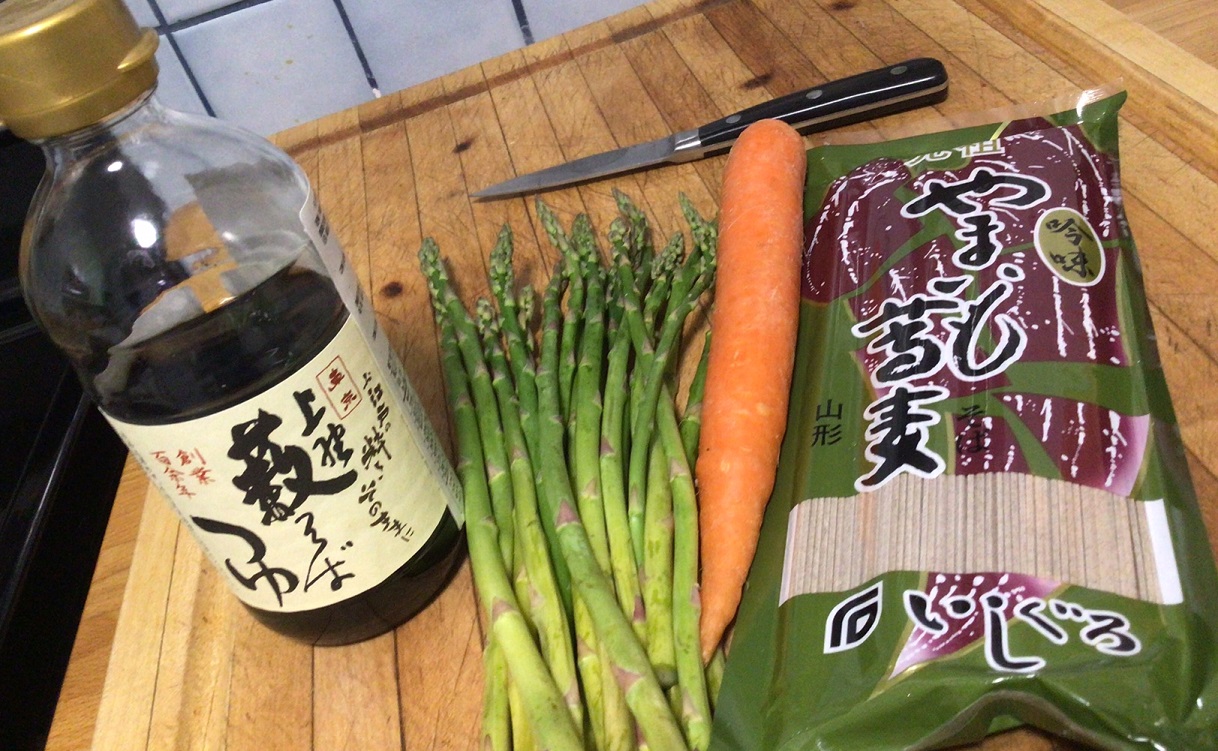
You can get all kinds of sauces and noodles from J Zone on Renfrew near 1st Avenue.
Trouble is, I’m not a good cook. But recently, I discovered a Japanese store called the J Zone (1663 Renfrew near 1st Avenue) that offers many beautiful sauces that I can use to make a tasty noodle dish. Some sauces can be simply tossed with hot or cold buckwheat noodles and vegetables, and some sauces need to be cooked. Just ask the kind person at the counter what to do. I tried a sweet, salty soy-mirin sauce, and it made a quick, delicious meal.
I truly believe that eating more vegetables has helped lower my cholesterol levels, according to my latest blood test. It’s a reason to celebrate with a French fry or two.
Fresh, in-season vegetables are packed with nutrients and fibre that are essential for heart health.
Heart-healthy soy-sesame buckwheat noodles with vegetables
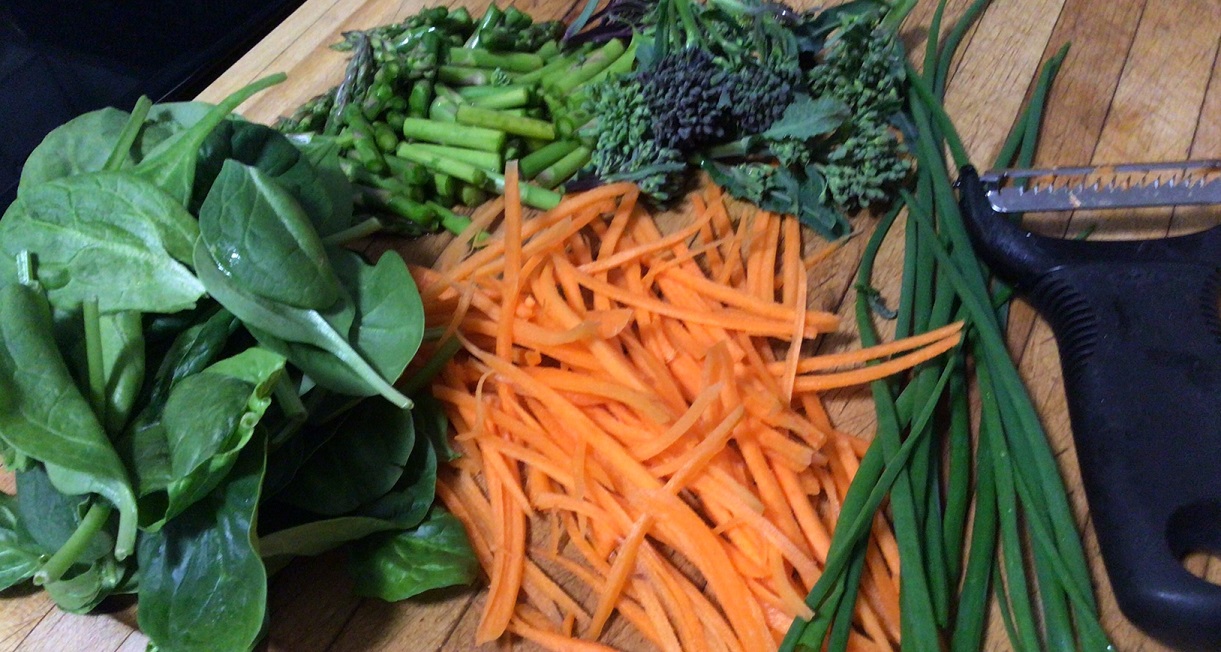
3–4 cups fresh vegetables such as carrots, asparagus, broccoli, spinach and green onion, julienned or chopped
3 dried shiitake mushrooms, rehydrated (soaked in water overnight), sliced thin
1 tablespoon olive oil
2–3 tablespoons soy-mirin sauce or sauce of your choice, or more to taste
12 ounces (350 grams) buckwheat noodles
2 tablespoons toasted sesame oil
Bring a large pot of salted water to boil and add the buckwheat noodles. Turn heat to medium and simmer until done, about 8 to 10 minutes.
Meanwhile, julienne the carrots and chop the asparagus, broccoli and green onion into bite-size pieces. Thinly slice the shiitake mushrooms.
In a large pan, heat the olive oil and add carrots and mushrooms. Stir fry for 2 minutes. Add the asparagus and broccoli and stir fry for another 2 minutes. Stir in the soy-mirin sauce, spinach and green onion. Remove from heat and cover.
When the buckwheat noodles are done, drain in a colander and rinse with cold water. Return the noodles to the pot and toss with the sesame oil. Add the vegetable mixture and toss.
Serve warm or cold.
Julie Cheng has been the editor of the Renfrew-Collingwood Community News for more than 15 years.
Martin L., Carmen L., and Sakshi J. are excited to host a series of events during Collingwood Days 2023 and to meet new neighbours and community members. Photo by Airam S.
This summer, a group of passionate neighbours and community members are gathering to explore the question “What makes Joyce-Collingwood special?”
Together, we will spend time getting to know each other, explore different ways to tell stories and create something through collaboration. The goal is to create something to share with the community at Collingwood Days 2023.
The program is loosely structured so that participants who join will help decide what and how we do things together. Our small but mighty group will be hosting a series of events throughout Collingwood Days 2023, including a jam circle, painting, community kitchen and a talent show.
There’s still time to get involved; we will meet every Wednesday in July from 6 to 8 pm in the Art Room at CNH Annex (3690 Vanness Avenue). Come and hang out with us!
This project is offered in partnership with Collingwood Neighbourhood House, who is generously providing space for this initiative to take place.
How to get involved
Are you someone who lives, works or spends time in Joyce-Collingwood and interested in creating something with other community members? Join this project by registering through the Collingwood Neighbourhood House online portal.
If you have any questions, concerns or would like to connect with the program facilitator, you can reach Carmen at 778-385-5128 (call or text) or carmenjlee@uvic.ca.
Program details
Program sessions are scheduled for 6 to 8 pm through June and July 5, 12, 18, 22 (Collingwood Days) and 26. Sessions will be held in the Art Room at Collingwood Neighbourhood House Annex (3690 Vanness Avenue).
Depending on the weather and group preference, some sessions may occur at a local park such as Slocan Park (2750 East 29th Avenue), Aberdeen Park (3525 Foster Avenue), Gaston Park (3470 Crowley Drive), or Collingwood Park (5275 McKinnon Street). Food will be provided for all participants.
Carmen Lee grew up in Renfrew-Collingwood and currently studies at the University of Victoria.
Staying sober in a social setting can be challenging. Being prepared and having a plan can help you enjoy going out after you’ve quit drinking. Photo by Julie Cheng
Being sober doesn’t have to mean giving up your social life, yet managing sobriety in a social setting (especially when alcohol is involved) can be a challenge. You may have concerns about going out after quitting drinking.
Can I have fun without drinking?
How will my friends react?
Will I feel self-conscious without a little liquid courage?
Can I say “no” and stick to it?
If you’re in early recovery, you’ll want to avoid any situation where alcohol or drugs are involved for some time. These environments can trigger cravings and put you at risk of relapse.
If you’ve decided to cut back on alcohol for your health or you’re more established in your sobriety, social environments that involve drinking may be easier to navigate. Still, being prepared and having a plan can help you enjoy going out after you’ve quit drinking.
Press play for sobriety advice
There are recovery-related podcasts that you can listen to. Some offer a different schedule each day, like the Ashes to Awesome podcast that streams on all major platforms. Here, Memorial Mondays feature a parent or loved one of an addict, Tuesdays feature someone sharing their own personal journey of recovery from addiction and Wednesdays feature some light-hearted humour and answers to listeners’ questions. Thursdays have some tips for people in or seeking recovery and then it’s on to Final Thought Friday.
Have an honest talk with friends
It’s up to you to decide how much information to share and who to share it with. You certainly don’t have to justify your decision. Some people drink and some people don’t. Everyone has their own choice to make and no explanation is needed.
If you have good friends who are likely to support your efforts, you might decide to have a direct and honest conversation with them. Tell them that you plan to avoid alcohol or that you’re cutting back.
Let them know what they can do to help. Perhaps you’d appreciate a sober buddy or someone else staying sober with you when you go out or helping you resist the temptation to drink. Or maybe you’d still like to hang out together, but not in bars. You might even still like to do the same things — such as playing cards or watching movies together — but without alcohol.
Hopefully, some of your friends will support your decision. In fact, some of them might also be thinking about cutting back on their own alcohol use and be inspired by you.
Be prepared for people’s reactions
While some of your friends may be totally supportive of your decision, others may seem indifferent or respond in a negative way. Your sobriety might serve as a reminder to your “drinking buddies” that they’re consuming unhealthy amounts of alcohol or stir up anxiety if they feel uncomfortable socializing sober. Or they may simply want you to partake alongside them because they think you’ll all have more fun together when drinking.
Just knowing a few possible reactions will ensure that you’re not taken by surprise and you’re able to cope:
Nagging: Your friends may say things like, “Come on, can you please just have one drink to loosen up a little?”
Teasing: You may get made fun of for being “boring” or “lame.” Some friends might say you can’t handle your alcohol or that you’re getting too old to drink.
Cajoling: Your friends might try to act as though they’re doing you a favour by buying you a drink, so you can “have fun.” Or they may try to convince you that if you just have one drink, they won’t tell anyone.
Peer pressure: Your pals might gang up on you a bit and try to talk you into having a drink. They may even pass out a round of shots and insist that you join in.
Confrontation: An upset friend may even confront you and insist that your unwillingness to drink is a sign of something bigger, like a “controlling partner” or “a midlife crisis.”
It’s important to be prepared for long-term changes from your decision to quit drinking. A change in your friendship dynamics doesn’t have to be a bad thing, however. You might find the shift welcoming. There’s always a chance that you’ll enjoy conversations with your friends more when you’re sober. And you may even find that they appreciate you more or respect your decisions.
And even if your friendships do change in a way that you don’t like, don’t despair. You might be able to create a new circle of friends or simply decide to hang out with your old pals in different locations and times when alcohol isn’t the main focus.
Go places that don’t serve alcohol
One of the easiest things you can do to avoid drinking — and to avoid having to explain yourself — is to go to places that don’t serve alcohol.
Look for places in your community that are alcohol free. From coffee shops, farmer’s markets and fast-food restaurants to movie theatres, museums and libraries, you’ll likely find plenty of spots that don’t serve alcohol.
You might go out alone as you start this new chapter of your life. Or you might invite your friends to join you in these places as a way to encourage sober activities.
Develop a few go-to responses
You aren’t likely to avoid alcohol all the time. Weddings, shows and even art galleries usually serve alcohol. And, of course, your friends may want to go to bars, clubs or other events where alcohol is one of the main attractions.
It’s important to prepare some go-to responses for how you’ll politely turn down a drink or handle questions about why you’re not drinking.
Depending on your comfort level and the person asking, you might decide to offer a direct, truthful response. Here are some options:
“I decided to stop drinking for a while.”
“I’m not interested in drinking tonight.”
“I gave up alcohol.”
“I’m cutting back on my drinking.”
“I’m driving tonight, so I’m not drinking.”
“I took a break from drinking and I love the way I feel now. So I don’t plan to start again any time soon.”
Of course, you don’t need to explain yourself. A simple, “I’m drinking seltzer tonight,” is enough. But if you know your friends are likely to give you a hard time or you know that you’re going to run into people who are going to insist you drink, having a few canned responses can prevent you from being taken off guard.
Have a non-alcoholic drink on hand
It’s helpful to have something in your hand at all times. If you go to a place that serves alcohol, maybe you can immediately order a non-alcoholic drink.
If you go to someone’s home, bring your own drink. Whether you have bottled water or a protein shake with you, keeping a drink in your hand can prevent people from offering you alcohol. It will also help you decline more easily if you are offered a drink, because you can say, “No thanks, I already have one.”
Think fun
When you walk into a situation believing that you can’t have fun sober, this is likely to be a self-fulfilling prophecy. You might even isolate yourself or hold back from having a good time — which will then reinforce your belief (and others) that being sober makes fun impossible.
Enter into the situation with a positive attitude and make the best of your time, even if you’re the only one not drinking. You might actually find that being sober is more enjoyable than you predicted.
Create an exit excuse
If you go out with people who are drinking and you’re not having fun, or you’re really tempted to drink yourself, then you’ll want to leave early. This is especially important if you’re going somewhere where you used to always drink before. The bar or the same nightclub you used to frequent while drinking may be a trigger for you.
While you can just leave or say you have to go without offering a reason why, you might find it’s more helpful to have a scripted excuse to quickly get out of the situation. A few examples:
You have to get up early for an event.
You’re not feeling so great.
You have plans to meet another friend.
If you’re in recovery and feel especially fragile or are craving alcohol even after you leave the environment, be sure to seek help. Call a trusted friend or family member or go to a meeting at a nearby support group.
Plan a productive morning after
You might find that one of the best parts about not drinking is that you don’t waste away the next morning sleeping and feeling hung over. Make the most of the time you gain by doing something enjoyable or productive.
Go for a jog, clean the house or run errands. Then take the rest of your day to enjoy your time. Having more time and energy might motivate you to continue abstaining from alcohol.
Try new things with your friends
If your friends are up for trying things that don’t involve alcohol, then you can make some suggestions.
Invite them to go to a park, a museum or on a hike.
Sign up for a class or new activity together.
You might find that you get to know each other much better when you’re creating new memories — rather than standing around in the same old bars. They might have fun exploring new places and trying new things with you.
Seek out people who don’t drink
You may need to shift your social circle to include people who don’t drink. This may seem tough at first. If you’re surrounded by people who make alcohol a big part of their lives, it can feel like everyone drinks.
But in reality, there are plenty of people out there who don’t drink — and who are looking for friends who don’t drink. You just have to find them. You might need to try new activities so that you can meet sober people, including:
Join a volunteer organization.
Attend events that don’t serve alcohol.
Join social media groups for people who participate in sober activities.
When you get together with such people, you’ll likely find that they do plenty of activities that don’t involve alcohol — like hiking, skiing, playing games or fishing. And you might even find that you enjoy doing these types of things much more than activities that involve alcohol.
Learn from your experiences
Consider every sober outing an experiment. You might make some mistakes — like drinking when you didn’t intend to or arguing with someone who offers you a drink. But you also might discover that you are happier when you aren’t drinking or that you really enjoy conversations with people more when you’re sober.
Learn from each experience. The information you take away can help you continue creating your best life.
For more guides, articles, how-tos and personal stories of recovery from addiction, check out the blog at the Together We Can website http://www.twcrecoverylife.org/news-blog. If you or someone you know need help navigating addiction and recovery, check www.twcrecoverylife.org
David Penny is the digital communications coordinator at Together We Can: Drug & Alcohol Recovery & Education Society.




 Renfrew-Collingwood Community News