Renfrew-Collingwood Community News

News stories from the Renfrew-Collingwood community in East Vancouver


1 Comment

Reflecting on five years of salmon returning to Still Creek

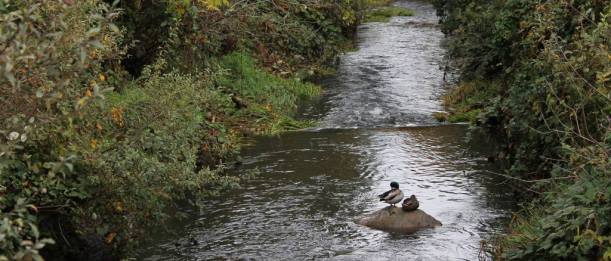
Still Creek photo with salmon and ducks

Still Creek at Natal Street and Cornett Road where chum salmon have appeared for the past four years. Photo by Kaitlyn Fung

BY CRECIEN BENCIO FOR STILL MOON ARTS SOCIETY

In the first week of November 2016, my neighbours and I are waiting. At Still Creek by Natal Street and Cornett Road, we step off the sidewalk and dodge the blackberry fronds. We are close enough that our fingers touch the water. Our eyes are alert for a flicker of a fin or a ripple.

For five years now this has been our ritual. This would be the fifth year salmon are to return to Still Creek in Vancouver. Still Creek is part of the Brunette River Watershed and is one of the major tributaries that feeds Burnaby Lake. The creek is partially hidden in culverts until it reaches Burnaby, where it flows above ground until it empties into Burnaby Lake. Chum salmon hadn’t made their way through these industrialized areas for 80 years until 2012.

I can feel the water seeping in through my shoes, but I am excited. This moment is part of the narrative our childhood – our environmental restoration efforts, the trees that we planted in the Renfrew Ravine now as big as we are, the silly garbage that we pulled out.

Personally, the salmon is a symbol of my own process of learning. This year, I have been more mindful of indigenous food sovereignty and the land that we are on. This journey has been confrontational and difficult. Through this, I learned how salmon is beyond species – it is linked to cultural knowledge systems, health, ecosystems, relationships and resiliency.

The salmon is a small wonder in my community. It surprises me how much I have learned from their returning presence. It surprises me how the many relationships I treasure revolve around their annual return. This year as I make my trek to the creek with friends I think, have the salmon heard our songs? Have they heard our dreams? For the past five years, this is where we have waited.

Still Moon Arts Society acknowledges that we are on the unceded, occupied, and traditional lands of the Sḵwx̱wú7mesh (Squamish), Xʷməθkwəy̓əm (Musqueam), Səl̓ílwətaʔ (Tsleil-Waututh), Sto’lo  nations, and for this we are thankful. Through creating art, restoring environment, and building community, Still Moon commits to  facilitating spaces for understanding and for knowledge sharing. This work will acknowledge and respect the contexts of the past and the present.

How can neighbours help the salmon and contribute to a thriving ecosystem in Renfrew-Ravine?

  • Do not use harmful chemicals, fertilizers, and pesticides.
  • Dispose of garbage, chemicals, paints and other liquids properly. Do not dump chemicals down the storm drain.
  • Wash your car without soap or with phosphate-free soap.
  • Participate in Evergreen’s Uncover Your Creeks program to take action to improve the health of Renfrew Ravine. For more information, visit evergreen.ca

Copyright (c) 2016 Renfrew-Collingwood Community News

1 Comment

Family tree tips for visiting your ancestor’s homeland

BY LORETTA HOUBEN

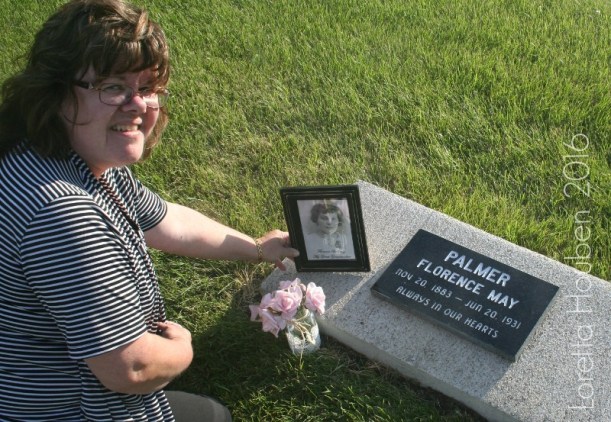
Loretta Houben beside her great- grandmother’s grave in Saskatchewan.

Loretta Houben beside her great- grandmother’s grave in Saskatchewan.

I have a curious mind and an adventurous spirit, so this summer when I knew I’d be attending a genealogy conference in Calgary, Alberta, I begged my husband to drive me to three places fairly close by where I knew my ancestors had once lived and worked. He kindly obliged and is now my hero! We travelled over 4,000 km by car to Three Hills, Alberta, and to Saskatchewan.

I’ve never experienced the vast prairie landscape before and it was spectacular. I had done my research ahead of time, but wasn’t exactly sure where my paternal grandpa had actually worked in Three Hills.

Our first stop was to consult the local museum in the town. Staff were very helpful and supplied us with a map to find the ranch. They also gave me a phone number for the owner, who was the great grandson of the man my grandpa worked for 100 years ago in 1916!

Loretta Houben at the Alberta ranch.

Loretta Houben at the Alberta ranch.

The original barn was still standing, and the house. It was fascinating to see the place and get a feel for the area in which he lived until he moved to Spalding, Saskatchewan.

We had booked all our hotels ahead of time. We used our GPS often so we never got lost. After the conference we headed to Humboldt in Saskatchewan. That’s a very long drive, but it was the highlight of my whole trip.

Earlier in 2016 I had joined a Facebook group for Saskatchewan and the members gave very helpful advice. One of them provided me with contact information for a local memorial business, and to make a long story short, the owner made a wonderful marker for my great-grandmother’s grave which had been unmarked for 85 years. Kind family members contributed money to help pay for the cost.

It was quite an experience to see my great-grandmother’s grave no longer lost but with a beautiful marker that included her name, full date of birth and death, and an epitaph which reads “Forever in our hearts.” The process of finding the grave and having the marker made and installed was all managed by email! I was quite impressed.

The next day we headed to Spalding, where my father was born. I had no idea where the farm was located, but thanks once again to Facebook groups, Garth Ulrich, who lived some distance away, said he would take us to all the places we wished to see.

It was a gorgeous day and we followed at 110 km per hour down dusty country roads as he showed us the various farms where my dad had grown up and also the school ground now overgrown with bush but which had a nice plaque to mark the spot where my dad had gone to school.

Another highlight was seeing the cemetery in the middle of wheat fields where my grandpa’s first wife is buried. Garth even provided a map of the cemetery so I could locate where her grave is, as there is one monument for everyone and no individual markers.

I’ll never forget my amazing genealogy adventure!

Loretta Houben is a long-time resident in the Collingwood area and enjoys making her family past come alive.

Copyright (c) 2016 Renfrew-Collingwood Community News


Leave a comment

Still Creek restoration aims to bring back salmon for good

BY EMILY DOYLE-YAMAGUCHI

Still Creek made history in 2012 when salmon defied the odds to navigate deep within the boundaries of Metro Vancouver and spawned here for the first time in over 80 years.

This breakthrough, hailed as a small but iconic victory for the entire region, proved what many thought impossible: even partially buried waterways with an intensive urban-industrial history can be recovered to the point where a variety of life returns. But can this hopeful glimmer of salmon be encouraged to stay for good?

Recent water quality improvements in Still Creek, and the addition of fish ladders that help make passage possible, have enabled a small group of chum salmon to reappear in their historic breeding grounds in East Vancouver. These resilient fish made a harrowing journey in the dark beneath major roadways to achieve their destination.

Two laneways - Still Creek

A tale of two laneways: Wall-to-wall asphalt (top photo) concentrates water and pollutants in the watershed, raises water temperature to levels that threaten fish survival, and increases the risk of flooding and pollution of Still Creek and the neighbourhoods that form the watershed. The materials used in the country lane (bottom photo) allow water to filter into the ground and move through soil, resulting in a low risk of flooding and cool water, which is vital for salmon survival, reaching Still Creek. The grass and other plants growing here also help to keep the environment cooler and provide food and habitat for birds and insects. Photos by Herb Hammond, Silva Forest Foundation

Now a bold vision is emerging to shift from a piecemeal to a systematic restoration of the Still Creek watershed, which is required to make a suitable home for an ongoing, and increasing, salmon population in the future.

What is a watershed?
A watershed is a drainage basin, like your bathroom sink, where water collects from rain and snow, and drains into a central location—in this case, Still Creek. The Still Creek watershed is part of the larger Brunette River watershed, which is part of an even bigger Fraser River watershed, which connects to the global watershed through the Pacific Ocean.

Salmon travel to Still Creek from the ocean by first swimming through the Fraser River, then up the Brunette River and into Burnaby Lake. The boundary of a watershed is defined by the shape of the landscape—high points mark the boundaries between different watersheds. Big watersheds are made up of many smaller watersheds.

What will restoration look like?
Much of the watershed’s natural water flow has been significantly modified with urban development. Restoring natural water flow as much as possible will be an important part of restoring the watershed—from improving water quality for salmon to providing habitat for native songbirds.

We can do this by changing impermeable surfaces to permeable surfaces, such as rain gardens and bioswales, to collect water and permit it to drain into the soil at a more natural pace. Multi-layered trees and shrubs act like a leaky umbrella in a rainstorm, allowing the water to drain into the soil slowly and tempering the impact of extreme storms that accompany climate change. This “green infrastructure” works better than storm water pipes to manage rainwater.

Who is running the project and how can I get involved?
The Still Moon Arts Society, Silva Forest Foundation, Simon Fraser University, the Greenest City Fund and the Charles & Lucille Flavelle Family Fund held at the Vancouver Foundation have teamed up to provide the science, funding and community vision that are required to restore the ecological health of Still Creek.

Working with residents, students, artists and the City of Vancouver, the project partners are developing a watershed-wide restoration plan that ranges from collaborating with local schools and “rewilding” city parks, to creating rain gardens and mini-rainforests in private yards.

To learn more about local restoration
Join the email list for updates and event info mail@stillmoon.org. Follow @stillmoonarts and on Facebook. Come to a workshop and tell Still Moon what you know about the watershed and learn about important restoration efforts you can initiate on your own property. Workshop information will be announced in the fall.

Emily Doyle-Yamaguchi is the project coordinator for the Still Creek ecosystem-based restoration plan. She may be reached at emily@silvafor.org.

Copyright (c) 2016 Renfrew-Collingwood Community News