Renfrew-Collingwood Community News

News stories from the Renfrew-Collingwood community in East Vancouver


Leave a comment

Family Tree Tips: Using Ancestry Library Edition at the Vancouver Public Library

BY LORETTA HOUBEN

The avid family tree researcher knows about ancestry.com or ancestry.ca. This is a powerful database with billions of genealogy documents stored online, accessible through an expensive membership unless purchased on sale. But are you aware that the ancestry site can be researched at your local library?

I attended a class to learn how to do this at the Collingwood Library in December 2018. Deanna from the Central Branch taught the hour and a half session. There were nine spots available, but only three people showed up that evening. We each were provided with a laptop to work with, and this made it easy to follow along as Deanna projected what she was doing onto a large screen.

Anyone with a library card can sign in to the computers available at the library. The Central Branch in downtown Vancouver has several computers with blue tags on top that can directly log into the Ancestry Library edition.

First you sign into Firefox, then add your library number and pin. Click the accept button, and then click on Digital Library, then choose Online Resources. Enter Ancestry Library Edition, then click on Find, then Access Now.

You will be able to search the census, vitals, military, immigration and quick links with member trees, birth, marriage and death records. Ancestry Library Edition includes most of the information found in a paid membership site, but the content is not exactly the same and some documentation might require paid membership to access. If you would like to know what databases are not included, the Central Branch has a printout for this, and other helpful printouts on tips for searching the Library Edition.

Deanna helped us navigate through some of the search pages by using the name John Smith. The class learned how to narrow down the different fields. For example, we explored the 1921 census for Canada. A map was shown under the search button, and we could click on it and narrow the search to a specific province.

When you discover a document you’d like to save, you can send the document home by email or add the information to a USB stick. I tried emailing and it was very easy to do.

The tips I learned were that if you do a broad or narrow search on names you will get a better result. Sometimes it’s difficult to find your ancestor’s name on a census, as the census takers often made up the surnames!

Another neat trick I learned was that the hammer and wrench tool on the side of an image means that if you click on it, you can print, download, rotate the image right or left, or flip horizontally!

Part of the database for the Ancestry Library Edition includes the 1851 to 1921 Census of Canada, US Border crossings from the US to Canada from 1908 to 1935, Canada City and Area Directories from 1819 to 1906, Canada Obituary Collection 1898 to 2015, Canada Ocean Arrivals 1919 to 1924 and Canadian Passenger Lists 1865 to 1935. To see the full list, pick up a printout at the Central Branch. The United Kingdom, England and Wales, Northern Ireland, Europe and the USA are also included.

To find out when the next Ancestry Library Edition class will be offered, search events on Vancouver Public Library online. The next one is Tuesday, January 15, 2019, at 6:30 pm until 8 pm.

I highly recommend taking a class. It will be like opening Pandora’s Box, and you will be surprised and delighted. You may also disappear down a rabbit hole or two for a few hours. Best of all, it’s free!

Loretta Houben is the author of the Family Tree Tips series published in the Renfrew-Collingwood Community News.

Copyright 2018 Renfrew-Collingwood Community News


Leave a comment

4 gardening tips for fall

Hydrangea

Do not be afraid to cut hydrangeas back quite drastically once they finish flowering. Photos by Julie Cheng

BY SOREN ELSAY

The days of tank tops and bare feet in the back yard have come to an end. However, as experienced gardeners know, garden work is a year-round process. While the spring and summer are where the excitement happens, what you do during the fall and winter plays just as crucial a role in your garden’s fortunes.

The conditions may be less than ideal for being outside, but make sure you find time to properly put your garden into hibernation mode by following these tips.

1. Plant bulbs

The best way to make sure springtime starts off with a bang is to plant bulbs in the fall. Aim for planting them from the middle of October until the end of November to see them emerge in full bloom in the spring. Make sure they are planted four to eight inches below the surface and most types, such as the ever-popular daffodils, should be planted in groups of five or more per hole.

Unfortunately, bulbs are a favourite treat of the local wildlife. Try deterring them by coating your bulbs in baby powder just before they get put in the ground.

Keep your bulbs dry at all costs while storing them. Wet bulbs tend to go bad very quickly. If a bulb is black or mushy, don’t put it in the ground and expect it to grow.

2. Cut down perennials

Perennials, as opposed to the one-season-and-done “annuals,” are plants that return every year. But that does not mean you let them wither and die though the winter. Cut down them down to the ground once they turn brown or begin to look unpleasant. They will be back.

Cut down perennials like peonies right to the ground once they turn brown.

3. Prune hydrangeas (if you have them)

Although brilliant when they flower throughout the summer, hydrangea bushes tend to get overgrown and hard to manage very quickly. To keep them under control, do not be afraid to cut them back quite drastically once they finish flowering. It’s not unheard of to prune it down to two-thirds or even one-half of its initial size. Always make your cut just above a fresh bud or at “crotch” (where a branch meets another branch).

4. Leave the leaves

Understandably most people like the tidy look of not having brown leaves scattered across their lawn; however, I would advise leaving or even putting a layer of leaves on top of your garden beds once the plants are done for the season. The leaves will provide both insulation against the cold for the bulbs still in the ground as well as an influx of nutrients as the leaves decompose over time.

Soren Elsay has worked as a professional landscaper. He is an aspiring writer with a bachelor of arts from the University of British Columbia.

Copyright 2018 Renfrew-Collingwood Community News


Leave a comment

Collingwood’s humble kitchen expert

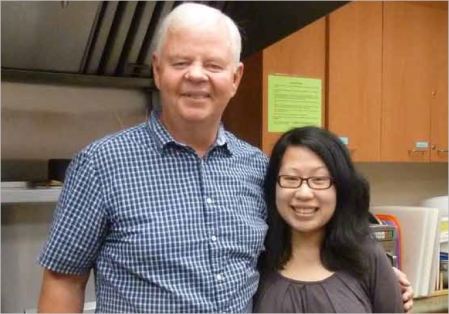
Barry Londry and Esther Yuen

Barry Londry tells writer Esther Yuen his story at the Collingwood Neighbourhood House community kitchen. Photo by Julie Cheng

BY ESTHER YUEN

To commemorate the 20-year anniversary of the Renfrew-Collingwood Community News, we’re revisiting past stories that have particularly inspired us. This article was first published in January 2013.
I got to learn about Barry’s rich and fascinating backstory. He’s a significant contributor to this community and it was an honour to interview him.
− Esther Yuen, writer

Barry Londry stands out from the crowd, literally. At six feet tall, he towers over most people in the Collingwood  neighbourhood, yet his warm smile and kind words put people around him at ease.

Barry’s a humble expert in the kitchen and can be often found tending shrubs in the Cheyenne community gardens. He’s also well known to improvise and create delightful dishes out of discarded food materials.

Just like these dishes, Barry could have easily thrown away parts of his life, but chose to create a meaningful life for himself that has positively impacted those around him.

You see, Barry had a thriving career as a chef―but this all of this came crashing down one day.

Years before Chef Barry joined the Renfrew Collingwood Food Security  Institute, Barry was just another kid growing up in the Vancouver eastside  neighbourhood called Diaper Hill. His parents, who moved here from the Prairies after the Second World War, fed Barry the typical Prairie diet of meat and potatoes―and on the rare occasion, they would cook him a delicious steak dinner.

Barry’s tastebuds were more adventurous, and even though Vancouver’s population then was quite homogenous, Barry was still able to develop a palate for exotic flavours. Every so often, Barry would hang out at his friend’s parent’s Chinese restaurant, and would visit ethnic restaurants with friends.

Whenever he found a dish that he enjoyed, he would ask the cooks for the recipes. Thus began his fascination with international foods.

While cooking was a hobby, he pursued a career in sports and business during his 20s. He studied restaurant management and completed a diploma in international business. He became a ticket distributor for sports games and even managed sales for the Stanley Cup games in the 80s. He also sold cider to the States!

Barry was business-savvy, but eventually realized that he couldn’t deny his passion for cooking. After he was laid off from a job in the beverages industry, he enrolled into the top cooking school in Vancouver, and then worked across the Lower Mainland in various food services capacities. Eventually, he found full-time employment as a chef in an assisted-living seniors’ centre.

In 2005, doctors discovered Barry had dilated cardiomyopathy, a condition  common among taller athletes. His heart was enlarged and was only at 13% capacity. As a result, he would often be tired and short of breath.

Determined to get well, Barry entered a recovery program. Unfortunately, weeks into the program, the heart specialist told him he was never going to be able to work again.

This hit Barry like a tonne of bricks. His life was going to be radically changed. No longer could he be independent, but had to be government-dependent, take on disability status and give up his car.

After dealing with the shock and the self-pity, he asked himself, “[Am I] going to sit here and moan or do something about [my life]?”

Barry went into action mode, and motivated himself to complete the  paperwork that accompanied his diagnosis.

Soon, Barry moved into the Collingwood area. Who knew that this would be another turn in his life?

In 2008, Barry went to an open forum at the Collingwood Neighbourhood House, intending to voice his opinion about the transit system. Instead, he met Stephanie Lim, then coordinator of the Renfrew Collingwood Food Security  Institute, who relentlessly pursued Barry to be involved with her programs.

He got his feet wet by building the Cheyenne Gardens with Jason Hseih and Steph, then eventually led and taught in food programs.

A few months later, Barry was asked if he could volunteer with Nadjia, who coordinated the community kitchen at Collingwood  Neighbourhood House. Barry thought he would volunteer for a few weeks, but eventually became a consistent participant, assisting Nadjia run the program to this very day.

Barry is still committed to perfecting the fine art of experimental cooking. He rarely writes down any of his recipes and almost never cooks the same meal twice, but he knows how to exactly combine foods to bring out the flavours.

His friend George, from John’s Market, once said, “[Barry’s] a better cook than me!” Those who have tasted his cooking would probably give him the same type of praise.

Esther Yuen is a communications specialist and graphic designer. She is passionate about positive social change and is active with the local arts and culture scene.

Copyright 2018 Renfrew-Collingwood Community News