Renfrew-Collingwood Community News

News stories from the Renfrew-Collingwood community in East Vancouver


Leave a comment

Annual Moon Festival lights up Renfrew-Collingwood

MOON FESTIVAL POSTER 2018

16th Annual Renfrew Ravine Harvest Moon Festival, Saturday, September 22, 2018

BY JUNE LAM

The annual Renfrew Ravine Moon Festival is back for the 16th year on Saturday, September 22, 2018!

A free event packed full of family fun, live music and art, the Renfrew Ravine Moon Festival has something for everyone. Each year, the festival attracts upwards of 5,000 participants from local East Vancouver neighbourhoods to enjoy displays of colour, light and music that pay homage to one of the last vestiges of urban forest in the city.

Co-produced by Still Moon Arts Society and the Renfrew Park Community Association, the festival celebrates the harvest abundance and the full moon.

The festival spans the afternoon and evening, going from a harvest celebration during the day to a lantern festival at night. As dusk gathers, a procession will form along the banks of the ravine, featuring lighted lanterns beautifully hand crafted by local artists, community members and students.

MOON FESTIVAL SCHEDULE

Harvest Fair: 4–7 pm
Slocan Park

The Moon Festival kicks off with the Harvest Fair, a home-grown harvest competition featuring entries by local gardeners of some of Renfrew-Collingwood’s best fruits, vegetables and flowers. Enter for a chance to win some awesome prizes! Alongside the presentations will be live music and food. You can also explore the booths of local organizations, artisans and non-profit groups from the community.

Twilight Lantern Walk: 7–7:30 pm
Slocan Park to Renfrew Park

The Twilight Lantern Walk is a sunset parade from Slocan Park to Renfrew Park. Festival-goers will light their own lanterns and walk the trails along the ravine, serenaded by live music as darkness falls. Passing by the river-stone labyrinth, you will be invited to join in a walking meditation surrounded by music and light. The parade will pass by art installations and maybe even surprise performances until it reaches Renfrew Park.

Lantern Festival: 7:30–8:45 pm
Renfrew Park

At nightfall, time slows down as you take in the beauty of candlelight, exquisite lanterns, ethereal music and the shimmering stream. Just outside of the stream, you will find musicians playing at the main stage, a Tea Garden full of delicious treats for you to enjoy and a final spectacle featuring dancing, stilting, fire spinning and fireworks.

PRE-FESTIVAL LANTERN WORKSHOPS

Take part in public lantern-making workshops prior to the festival. For a small fee, you can come out to the Collingwood Neighbourhood House Annex (on Vanness Avenue between Boundary and Ormidale) or Slocan Park Fieldhouse (at Slocan and East 29th Avenue) to make a lantern to bring along to the twilight walk!

Sept. 10, 11: Salmon Lanterns (47 pm) at Collingwood Neighbourhood House Annex
Cost: $25

Sept. 12, 13: Bird Lanterns (47 pm) at Collingwood Neighbourhood House Annex
Cost: $25

Sept. 8, 15: Bird-Themed Community Art Installation (14 pm) at Slocan Park Fieldhouse
Cost: By donation

Sept. 17, 18: Globe Lanterns (47 pm) at Slocan Park Fieldhouse
Cost: $15

Sept. 19, 20: Glass Jar Lanterns (47 pm) at Slocan Park Fieldhouse
Cost: $10

ADDITIONAL ACTIVITIES

Mooncake Workshops

Reserve your spot by calling 604-435-0323 or paying in person at Collingwood Neighbourhood House front desk.

Sept. 7 at 10:30 am–12:30 pm (Chinese)
Sept. 11 at 5:30–7:30 pm (English)
Where: Collingwood Neighbourhood House Annex
Cost: Pay-What-You-Can, suggested donation $20

Moon Music (57 pm)

Sept. 10: Renfrew Park Community Centre
Sept. 14: Collingwood Neighbourhood House Annex
Sept. 17: Slocan Park

For more information, visit stillmoon.org or Facebook @stillmoonarts.

June Lam is a long-time resident of Renfrew-Collingwood and the communications coordinator for Still Moon Arts Society.

Copyright 2018 Renfrew-Collingwood Community News


Leave a comment

Let’s celebrate literacy in September

BY JANICE BEXSON

From the time we wake up and until we go to sleep, literacy plays an integral part in everything that we do.

Literacy Is Life logo

Image source: decoda.ca

Whether we are checking the weather forecast, reading the instructions on how to make a breakfast shake, knowing the number of the bus that will take us to our destination, reading and answering emails and texts, ordering lunch and paying the bill, driving to a new destination, buying groceries, helping a stranger or tourist read a map to find a specific Air BNB, checking a bank statement, reading a story book to a child before bedtime or setting the alarm for tomorrow, we need and use basic literacy skills in order to achieve these activities in our work and in our daily lives.

However, these literacy skills are not just about learning how to read and write. They also involve knowing how well we use our literacy skills so that we can participate more fully in our community. Using existing and gaining new literacy skills increases our self-confidence, encourages connection to others, and expands our health, social and economic opportunities.

In British Columbia (B.C.), Decoda Literacy Solutions (Decoda) has declared September “Literacy Month.” Decoda supports community organizations in B.C. (including Collingwood Neighbourhood House) with funding, training and resources for a variety of literacy initiatives. Decoda’s “Literacy Is Life” campaign raises awareness about literacy and hosts a variety of activities throughout September.

As the lazy days of summer gently ease into fall, children return to school and adults generally shift from leisure to work mode, so September is the perfect month to think about how we can continue to foster literacy.

How can I foster literacy?

Well, there are many ways to involve literacy learning in your busy lives during September. A few examples include:

  • Play board games that inspire spelling, mathematical and logical thinking, such as Scrabble, UpWords, Qwirkle and Rush Hour.
  • Read a book out aloud, instead of silently.
  • Instead of using your GPS (global positioning system) to help you find a new destination, try using a good old paper map (the most updated copy you can find).
  • Challenge yourself and discover what 20 abbreviations or acronyms mean (e.g. GPS, ASAP, etc.)

Fostering our literacy skills involves constantly challenging ourselves, so that we continue to maintain and strengthen those skills. “Practice makes perfect”’ as the saying goes or “practice makes better,” as I prefer to say.

So, go ahead – this month, find out what literacy initiatives exist in the Renfrew-Collingwood neighbourhood, and take some time to visit Decoda’s website (www.decoda.ca) and view the Literacy Is Life campaign. Have a good Literacy Month!

Janice Bexson is the literacy outreach coordinator at the Collingwood Neighbourhood House.

Copyright 2018 Renfrew-Collingwood Community News

Leave a comment

Family Tree Tips: Begin at the beginning

Family-Tree

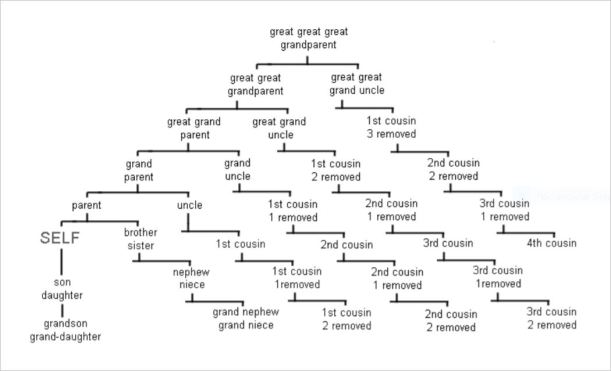
An example of a family tree. Also look online for examples of pedigree charts. Image courtesy of Margaret Houben

BY LORETTA HOUBEN

The majority of us are the descendants of immigrants. Not too far in our distant past, either our parents, grandparents or great-grandparents relocated to this wonderful country of Canada, and somehow wound up in the Renfrew-Collingwood area.

While growing up here I was aware that my mother’s side of the family lived in Oregon and my father’s side of the family lived in the Lower Mainland. While researching my dad’s past in 2011, I became obsessed with the “hows and whys” of their move from the prairies where they previously lived.

My dad was born in Spalding, Saskatchewan, but his parents both came from Wales. His father came alone to Canada in 1910, and his mother arrived in 1927 as a young woman of 19, along with her parents and siblings.

Although my grandpa was born in North Wales, and my grandma in South Wales, they met on the prairies and eventually wound up here on the West Coast.

My mom’s family are German and moved to Texas, USA in 1910 to escape political and religious turmoil in the land of Russia. They got out just before the Russian Revolution and the First World War erupted close to their farm. Due to their farming expertise, they were able to save up money and purchase acreage in Amity, Oregon.

Through a series of events, my parents met and wound up in the city of Vancouver, far removed from their farm roots. It’s fascinating how the dots connect and if you know how to research you can connect them even further back and discover clues as to how and why your ancestors chose Canada or the USA to move to.

The word genealogy means “a record or account of the ancestry and descent of a person, family, group; the study of ancestries and histories; and the descent from an original form or progenitor; lineage; ancestry.” Everyone’s genealogy will of course be different and unique, which is why genealogy is now so popular, especially with the TV show series Who Do You Think You Are in Britain and the USA.

Thanks in large part to digitized documentation being uploaded to the internet by various organizations, a search into the past is now convenient and fairly easy, although when I began my journey of genealogy research I never knew how addictive it would become! If you have patience and your family information is intact, you will be rewarded as you search.

The first thing to be done is to fill in a family tree. Begin with yourself and your birth date and place of birth. Add your parent’s names and their birth dates and place of birth. If your parents are living, ask them for the names of their parents and dates/places of birth. Hopefully you will have this much to begin with.

I keep my paper copies in binders, inserted into clear plastic sheets. I found some lovely binders at Daiso Dollar Store in Aberdeen Mall in Richmond, which already have the clear sheets inside. They are a reasonable cost of $2 each and have 40 pages. Also keep a copy of everything on your computer and remember to do weekly backups.

A home photocopier/scanner unit is a marvellous asset in your family tree hobby. A clear concise way of keeping track of the information you will be adding is a definite must in genealogy research. You need to make files and update them regularly. Each person has their own system.

There is no right or wrong way to do this. Part of the hobby of genealogy is gathering information which is turned into charts but the fun part is the stories that come to light!

Here is a chart so you can begin as soon as possible. The best goal in your family tree research is not to put off to tomorrow what can be done today! And who knows, maybe you have someone famous or well known in the branches of that tree.

In the next installment, popular genealogy websites will be discussed, as well as a local British Columbia genealogical society who host free monthly meetings at the Vancouver library central branch.

Loretta Houben is deeply involved in researching the mysteries in her paternal family tree and has been quite successful in 2013.

First published in the September 2013 issue of the Renfrew-Collingwood Community News.