
For decades, Harvey’s was the social hub of the community, especially on Saturdays. You could say Harvey’s was the Facebook of its time, at least here in Collingwood. Photos courtesy of Harvey’s
BY PAUL REID
Well folks, we’re at the end of an era with Harvey’s closing their doors after 88 years in business. I could be wrong, but I believe that would make them our community’s oldest surviving business. To everyone at Harvey’s – Way to go you guys. That is an amazing accomplishment!
Florence and Albert Harvey first opened Harvey’s on Kingsway in 1927 and started out selling wool and sewing notions. The store soon expanded and by 1936 they were selling their first appliances in the form of wooden coal and oil stoves.
Harvey’s grew over the years and added more and more stock: house wares, hardware, plumbing supplies, wood stoves, rifles, outboard motors. Later they would carry toys, bikes and the electric appliances and furniture that made them famous. Today, Harvey’s boasts over 38,000 square feet of showroom that is stocked with some of the most desired home décor and appliances available on the market today.
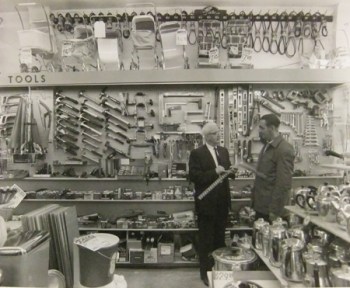
Richard Harvey (left) took over the business from his parents in the early 1960s.
Over the years, the business passed within the family from Albert to his son Richard. Richard took the helm in the 1960s up until his passing eight years ago. Now it is Richard’s son, Eric Harvey, who, after been born into the business some 60-odd years ago, has been working hard ever since. “It’s our work ethic that has kept us going,” says Eric. “That and a personal touch.”
It was also a place to meet up with your neighbours. Eric recalls how there was also a barber shop, a shoe store and a skate shop (for hockey) on the property. So it really was like Andy Griffith’s Mayberry with everyone meeting there to catch up and share the latest news and gossip. I guess, in a way, Harvey’s was the Facebook of its time, at least here in Collingwood.
Another employee who virtually grew up at Harvey’s was Wayne Elliot. Now in his 54th year of duty with Harvey’s, Wayne, Eric’s buddy, has worked there nearly all his life. They spent their youth working till closing at Harvey’s and then going next door to hang out at Wally’s Drive-In. Yup, those were the days. He did have one job prior to Harvey’s. It was across the street.
Walking by the store one day, Eric’s uncle, who was washing the front windows, asked Wayne if he wanted a job. He said no, he had a job across the street at Docksteader Drugs. How much you making there, asked the uncle. Fifty cents an hour, said Wayne. I’ll give you 55. And with that, Wayne took over washing the window and never looked back.
Working at Harvey’s even longer than Wayne is Jimmy Geekiy. Jimmy has been a plumber with Harvey’s now for 58 years. Jimmy remembers when there used to be line-ups down Earles Street to get in on. “In this area, we were it and it was busy.”
Eric’s wife Donna, who has 25 years working in Harvey’s offices, sees it as a natural progression. But the old customers have been coming back in droves to have maybe one last shop before closing day. For the first four days of the sale, again there were line-ups to get in.
“The response of our customers has been really heart warming. People who have heard about the closing have been coming by just to say hello or reminisce. People sometimes bring their children in to show them the place; others are phoning. For many, it’s kind of like if your family home was about to be torn down,” says Donna.
“These days shopping is seen as a chore, but back then shopping was an event,” says Donna. “People would come in and buy a new appliance or dining room set and it was a big deal for them. Some who come in remember the exact month and year that they bought something here. There is a woman who still comes in; she is 98 years old and she still has a hanky that she bought from Eric’s grandmother. That’s amazing!”
“Back then, nobody had credit, but Harvey’s, especially maybe around Christmas, when someone just didn’t quite have enough money, would trust them. And in this way, they built a rapport with the community and this is why Harvey’s lasted as long as it did. There are still many who patronize us because we were and still are a small family business. And all this time we have tried our best to keep that heart. People were loyal to Harvey’s. You just don’t get that kind of loyalty now with stores.”
How is Eric taking the closing out? “I don’t think it’s really sunk in yet,” he says. Eric is now just focused on what he needs to do to sell off approximately $3.5 million worth of stock. It’s been a lot of work closing the store. Lucky for us consumers out there, that means a great sale.
Have a look at the back page for more about Harvey’s big sale and then go check out Harvey’s, even if for old time’s sake.
The Collingwood Neighbourhood House and Renfrew-Collingwood Community News give a BIG thank you to Harvey’s for all of their support and service over the years.
Copyright (c) 2016 Renfrew-Collingwood Community News


