Renfrew-Collingwood Community News

News stories from the Renfrew-Collingwood community in East Vancouver


Leave a comment

Common Voices: The Cultural Legacy of Italian and Cantonese Opera in Vancouver

Exhibit at Italian Cultural Centre’s Il Museo runs until July 15

Chinese-Opera-Common-Voices

Rosa Cheng, Vancouver Cantonese Opera, 2016. Photos courtesy of the Italian Cultural Centre

BY ANGELA CLARKE

Spanning May and June, which are Asian and Italian heritage months, the Italian Cultural Centre mounted an exhibition on the history of Cantonese and Italian opera in Vancouver. While these two art forms evolved independently from two diverse musical traditions, they share significant commonalities as major performance genres spanning the cultural history of the Chinese and Italian communities in Vancouver.

Both art forms have been practised in Vancouver since the beginning of immigration to this area, around 1885. They are known for their elaborate costuming and make-up, as well as the immense skill required of the artists who devote their lives to interpreting these musical genres.

While both musical forms are viewed as an acquired taste, often requiring some knowledge of the music and its history before they can be appreciated, historically, they have contributed significantly over the last century to the cultural landscape of Vancouver. Both genres have enabled both the Chinese and Italian communities to remain connected with their cultures of origin as they have negotiated their way in their new home of Canada.

Art, opera and cultural discrimination

Vancouver-Opera-Common-Voices

Vancouver Opera, Norma, starring Joan Sutherland, 1963.

The story of Italian and Cantonese opera also tells the story of discrimination and isolation. For both Italian and Cantonese communities in Vancouver these musical genres were often performed as a means to create community and connection in times of duress.

The exhibition tells the story of the Italian men interned in the work camps of Kananaskis in Alberta and Petawawa in Ontario, who created a camp choir of internees. These men, surrounded by armed guards, travelled around the countryside performing scheduled appearances. Despite being under heavy surveillance they were in demand among the civilian communities around Petawawa. There was even a professional opera singer, Piero Orsatti, among them.

For the Cantonese-speaking men living in Vancouver’s Chinatown, Cantonese opera and its performance was a means to create a haven for men who could not speak English, and due to the laws of exclusion, where banned from bringing family to Canada. Cantonese opera was a means of creating a foundation of familiarity in an unfamiliar and hostile environment.

For the Chinese men who immigrated to Vancouver for work on the railway, Cantonese opera was compelling not only because of the language but also for the many female performers who travelled from China in theatrical troupes. Certainly the story of Cantonese opera in Vancouver is an important and unique vignette offering scholars important insight into the history of women in Vancouver performance history. Women performers drew large audiences in Vancouver in the 1920s and ’30s, a full decade before women were even allowed to perform in their native China. As well, despite the traditionalism of the art form, these female artists, performing along the West Coast of the United States and Canada, became renowned for their alluring sense of style and the adoption of North American silver-screen aesthetics.

Currently Cantonese opera in Vancouver still continues to be relevant largely due to the female performers. In the Chinese community, women train as interpreters of this genre later in life, desiring to reconnect with their culture in retirement. Women train to interpret both the male and female roles.

Today Italian opera continues to emerge from its Eurocentric origins, finding contemporary relevance in plot lines located in post-colonial environments. As part of the repertoire for the Push Festival in 2017, Third World Bunfight produced a modern retelling of Verdi’s opera Macbeth. This full-length opera relocated the traditional plotline from medieval Scotland and placed it into the current political realities of the Congo in territories governed by military dictatorships. This production was supported by Vancouver Opera and the Italian Cultural Centre.

This exhibition on the history of Cantonese and Italian opera in Vancouver features historic costuming and interactive video to animate this story. The exhibition runs until Saturday, July 15, 2017.

Angela Clarke is the museum director and curator at the Italian Cultural Centre Museum. The Common Voices exhibit has been supported by Canada Heritage, the Museum of Migration and the Italian Cultural Centre.

Copyright (c) 2017 Renfrew-Collingwood Community News


Leave a comment

Happy 100th birthday to John Harlow

BY PAUL REID

Harlow-family

Three generations of transit operators (from left to right) David, Michelle and John Harlow in front of the family home on Chambers Street. Photos courtesy of the Harlow family

To commemorate the 20-year anniversary of the Renfrew-Collingwood Community News, we’re revisiting past stories that have particularly inspired us. This article was first published in June 2017.
Reading the RCC News gives a wonderful glimpse into the lives of local residents. This story celebrated the milestone 100th birthday of John Harlow with a look back at his rich, rewarding life. Staff writer Paul Reid chronicles how John’s love and passion for his work in the transit industry was passed through his family to create a multi-generational connection.
− Lisa Symons, sales and distribution coordinator

Herbert Harlow and Rose Campbell met while working at Vancouver General Hospital. They married and had their first born, John, in 1917. In 1925, John’s wife-to-be, Georgette, was attending Norquay School. John and Georgette met when they attended South Vancouver high school (now John Oliver), married in 1939 and moved onto Chambers Street. Three of their four children would also attend Norquay School.

John would later build a new house on Chambers Street in 1950. He bought the double lot for $600. This is the house he still lives in today with his son David and David’s wife Sylvia. So, we have had a Harlow living on Chambers Street for more than 78 years.

We have also had a Harlow driving city buses in Vancouver since 1945. This is the year that John started driving city buses for Neville Transit. Even before that, John was a driver, driving trucks for the Boeing company on Sea Island during the Second World War. He remembers driving up to the gate one day and the guard told him to park the truck and go home. The war was over, the plant was closed and everyone was laid off! That same day, on his way back home, John would not only find a new job, he was taught his route and started driving that day!

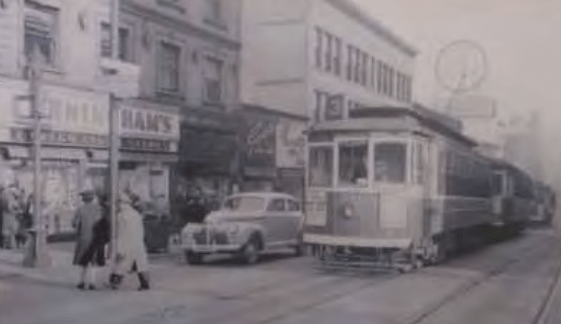
Streetcar

John Harlow became a motorman, driving streetcars like this one for Neville Transit.

This was the job with Neville Transit that would start the continuing legacy of the Harlow family. John worked with Neville until they became BC Electric and later BC Hydro. During this time, John became a motorman, driving streetcars.

In 1978, John’s son David would join the transit team. It was around this time that the company would became Metro and then Coast Mountain. In 2004, David’s daughter, Michelle started driving, becoming the third generation of Harlows to do so. (John retired in 1979; David in 2009.)

Harlow-baby

Congratulations to Michelle and the Harlow family on this latest addition this year. Could this be the fourth generation of the Harlow-transit legacy?

For John’s 100th birthday, his family wanted to give him a ride down memory lane. So they rented a vintage 1964 GMC bus, provided by TRAMS, and along with family and friends, the day was spent touring with John down memory lane.

This tour included John’s old routes in East Vancouver; Sea Island where John worked with Boeing; past the school where he met his wife; and the church where they got married.

Needless to say, John had a fantastic 100th birthday.

Copyright 2017 Renfrew-Collingwood Community News


Leave a comment

Collingwood Corner: Home Delivery in the 1960s

BY LORETTA HOUBEN

Once upon a time there weren’t online stores like Amazon. There weren’t personal computers, tablets or cell phones. Apparently, humanity was cut off from one another, living in a vast void.

Dairyland-Home-Delivery-1965-List

Home delivery price list from 1965. The prices are simply astounding. Image from the collection of Loretta Houben’s parents

Not quite. Growing up in Collingwood over 50 years ago, homemakers had access to home delivery options. One of them my parents subscribed to was Dairyland Home Delivery.

Please study the prices of the attached 1965 price list. For a growing family, usually consisting of two parents and four or more children, you had the option of an eight-quart family milk pack for $2.23. This was in the days before metric conversion. A quart of milk was 29 cents.

Along with a variety of milk products you could indulge in cream, whipped cream, apple and orange juice, yogurt, cottage cheese and butter. Butter was 66 cents for one pound.

The prices were comparable to a working man’s wage. My dad earned $150 per month working for the Glidden Paint Company as a forklift driver, yet he could indulge in home milk delivery.

I remember the pale yellow truck rumbling down our street early in the morning, and the bottles clanking as they were set on our front porch. Of course, the dairy products were all in glass containers, which my mom washed and set out the next week.

Another wonderful sound of a truck stopping outside our home quite often was the Simpson Sears truck from the warehouse in Richmond. Each season every home in Vancouver would receive a thick free Simpsons catalogue to dream over, filled with useful and exotic items for the home or your wardrobe.

Your order was placed by telephone one day, and your goods were delivered without charge the very next afternoon.

Once, age three, I remember a large brown paper covered box arriving at the front door. My mom paid the delivery man, and quickly hid the package in her closet. I begged her to see what it was, and so she emptied the box and gave it to me to play with.

I could smell that there had been a new doll in it! I cried and cried until my mom relented (for reasons unknown) and gave me the doll, which was meant to be a Christmas gift!

Woodward’s and Eaton’s also had home delivery, but Simpson Sears was my parent’s first choice.

Do you have memories of those long-ago days, and free delivery to your door?

Loretta Houben is a long-time resident of Collingwood and coordinates the Seniors Connection section of the Renfrew-Collingwood Community News.

Copyright (c) 2017 Renfrew-Collingwood Community News