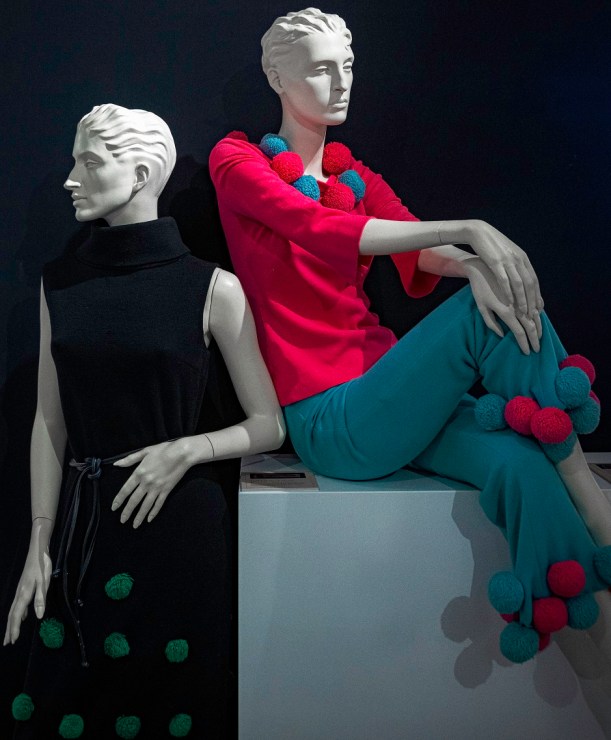
The knit pom poms on these two outfits hark back to clowns, a popular stock character in Italian opera. Italy has a long history and strong heritage in professional theatre with Commedia dell’arte (“Italian comedy”). One of the most famous Italian operas is Pagliacci (Italian for “clowns” or “players”). Photos courtesy of the Italian Cultural Centre
New exhibit at the Italian Cultural Centre
All’Italiana
Italian Cultural Centre
3075 Slocan Street, Vancouver
http://www.italianculturalcentre.ca
Tuesday to Saturday, 10 am to 5 pm
BY DEANNA CHENG
The latest exhibition at the Italian Cultural Centre focuses on the highlights of Italian fashion in the 20th century, featuring garments by Pucci, Schiaparelli and Fortuny.
Guest curator Ivan Sayers wanted to focus on Italian fashion because the spotlight is usually on French, American or British fashion. “Italy is extremely important, especially in leather goods and accessories but also with mainstream garments.”
The show is an opportunity to admire Italian ingenuity, wit, craftsmanship and quality, he said.
On display until April 25, All’Italiana (“in the Italian style”) is part of a celebration of craftsmanship by the Craft Council of BC. The theme of this year is “voices of craft.”
Sayers said, “Craft usually means handwork.” And handwork is visible in the handmade raffia lace of the Fortuny dress, he said, and in the decoration on the Schiaparelli coat. “It’s beading. It’s eccentric. It’s still labour intensive.”
He added, “When you look at the Prada suit, initially, it seems banal but when you start to look at the seaming and the skirt, you start to appreciate what’s gone into it, lifting it from boring to intriguing.”
There’s construction, decoration, ratio and proportion that people tend to ignore, but it still has value, he said.
Museum curator Angela Clarke said the exhibit explores craft because it often gets a bad name. “Craft is often looked at as something that you often find in your grandmother’s place. You know, doilies.”
It’s often seen as surface design without much in terms of artistic integrity, originality, a voice of the artist or social commentary, she said. “Craft is often recreating a tradition. There are often patterns incorporated into craft that have been used almost like a stencil.”
When you knit, you base it on a pattern, Clarke said. If you embroider, you base it on a pattern. “And that is sort of a counter to this notion that all art creation is individual and it’s a one-off. So craft gets a bad name for that.”
Garments are considered like that because they have a pattern. The world of fashion is changing because it’s the name of the designer that we come to for and that often separates craft from art, she said.
Historically, there were some names that were developing such as Schiaparelli through the 1930s and Christian Dior in the late 40s and 50s. It’s not to the same degree as today, she said, where the name is everything. “We now have celebrities with clothing lines and certainly, they’re not the ones designing and making the garments at all.”
She said, “Today, everyone wants to be a designer but no one wants to be a tailor.”
“The fact is that craft often represents underrepresented voices,” added Clarke.

Guest curator Ivan Sayers said Italy is the birthplace of lace. Italian lace comes from the fishing culture in small Italian towns, drawing inspiration from fishing nets.
For example, textiles and embroidery were considered the realm of women’s history, she said. “And for the most part, that’s all we’ve got of women’s history for the middle and lower classes. Anything out of the household, the domestic space, it’s all about women.”
Italian fashion also constantly refers to its own history from the materials to the construction. For example, Clarke said, Italian lace arises from fishing culture as an improvisation of the fishing net.
The fishing net has become part of the cultural consciousness of Italian villages because it’s the major industry. “You get these towns, these whole towns, that are in Italy that are devoted to certain craft industries such as Venetian glass and ceramics.”
It’s partially so they can share resources, she said. The other part is due to technology used for the flammable arts.
If you were to make anything glass or ceramic in Rome, Venice or Milan, the whole city would go up in flames in half an hour if there was an accident because buildings were made of wood, Clarke said.
Legislation was created, stating these industries had to be 10 miles outside of a major city centre.
Another sign of Italian heritage is the knit pom poms on the Paoli dress. The colourful fluffy attachments refer to the clown, popular in Italian opera, she said. The significance of this character spread across Europe by travelling Italian troupes.
“Clowns show up repeatedly because it’s the stock character of a figure that can say anything, do anything, and you feel compassion for them,” Clarke said. “It’s like the joker in Shakespeare. He’s the one who entertains the king but he’s the only one that can actually speak the truth.”
Rich Nguyen, an attendee, visited Italy last year and the selection of Schiaparelli and Pucci within the exhibit speaks to him the most as “Italian.”
This collection features garments from the collection of fashion historian Ivan Sayers, the Museum of Vancouver and the Society for the Museum of Original Costume.
Deanna Cheng is a freelance journalist and copy editor. Her work has been published in New Canadian Media and Vancouver Courier. She has also been a resident for the last 15 years. Contact: dmwcheng7@gmail.com.


 Renfrew-Collingwood Community News