Renfrew-Collingwood Community News

News stories from the Renfrew-Collingwood community in East Vancouver


Leave a comment

Collingwood’s humble kitchen expert

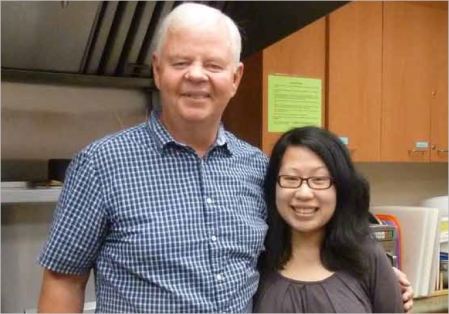
Barry Londry and Esther Yuen

Barry Londry tells writer Esther Yuen his story at the Collingwood Neighbourhood House community kitchen. Photo by Julie Cheng

BY ESTHER YUEN

To commemorate the 20-year anniversary of the Renfrew-Collingwood Community News, we’re revisiting past stories that have particularly inspired us. This article was first published in January 2013.
I got to learn about Barry’s rich and fascinating backstory. He’s a significant contributor to this community and it was an honour to interview him.
− Esther Yuen, writer

Barry Londry stands out from the crowd, literally. At six feet tall, he towers over most people in the Collingwood  neighbourhood, yet his warm smile and kind words put people around him at ease.

Barry’s a humble expert in the kitchen and can be often found tending shrubs in the Cheyenne community gardens. He’s also well known to improvise and create delightful dishes out of discarded food materials.

Just like these dishes, Barry could have easily thrown away parts of his life, but chose to create a meaningful life for himself that has positively impacted those around him.

You see, Barry had a thriving career as a chef―but this all of this came crashing down one day.

Years before Chef Barry joined the Renfrew Collingwood Food Security  Institute, Barry was just another kid growing up in the Vancouver eastside  neighbourhood called Diaper Hill. His parents, who moved here from the Prairies after the Second World War, fed Barry the typical Prairie diet of meat and potatoes―and on the rare occasion, they would cook him a delicious steak dinner.

Barry’s tastebuds were more adventurous, and even though Vancouver’s population then was quite homogenous, Barry was still able to develop a palate for exotic flavours. Every so often, Barry would hang out at his friend’s parent’s Chinese restaurant, and would visit ethnic restaurants with friends.

Whenever he found a dish that he enjoyed, he would ask the cooks for the recipes. Thus began his fascination with international foods.

While cooking was a hobby, he pursued a career in sports and business during his 20s. He studied restaurant management and completed a diploma in international business. He became a ticket distributor for sports games and even managed sales for the Stanley Cup games in the 80s. He also sold cider to the States!

Barry was business-savvy, but eventually realized that he couldn’t deny his passion for cooking. After he was laid off from a job in the beverages industry, he enrolled into the top cooking school in Vancouver, and then worked across the Lower Mainland in various food services capacities. Eventually, he found full-time employment as a chef in an assisted-living seniors’ centre.

In 2005, doctors discovered Barry had dilated cardiomyopathy, a condition  common among taller athletes. His heart was enlarged and was only at 13% capacity. As a result, he would often be tired and short of breath.

Determined to get well, Barry entered a recovery program. Unfortunately, weeks into the program, the heart specialist told him he was never going to be able to work again.

This hit Barry like a tonne of bricks. His life was going to be radically changed. No longer could he be independent, but had to be government-dependent, take on disability status and give up his car.

After dealing with the shock and the self-pity, he asked himself, “[Am I] going to sit here and moan or do something about [my life]?”

Barry went into action mode, and motivated himself to complete the  paperwork that accompanied his diagnosis.

Soon, Barry moved into the Collingwood area. Who knew that this would be another turn in his life?

In 2008, Barry went to an open forum at the Collingwood Neighbourhood House, intending to voice his opinion about the transit system. Instead, he met Stephanie Lim, then coordinator of the Renfrew Collingwood Food Security  Institute, who relentlessly pursued Barry to be involved with her programs.

He got his feet wet by building the Cheyenne Gardens with Jason Hseih and Steph, then eventually led and taught in food programs.

A few months later, Barry was asked if he could volunteer with Nadjia, who coordinated the community kitchen at Collingwood  Neighbourhood House. Barry thought he would volunteer for a few weeks, but eventually became a consistent participant, assisting Nadjia run the program to this very day.

Barry is still committed to perfecting the fine art of experimental cooking. He rarely writes down any of his recipes and almost never cooks the same meal twice, but he knows how to exactly combine foods to bring out the flavours.

His friend George, from John’s Market, once said, “[Barry’s] a better cook than me!” Those who have tasted his cooking would probably give him the same type of praise.

Esther Yuen is a communications specialist and graphic designer. She is passionate about positive social change and is active with the local arts and culture scene.

Copyright 2018 Renfrew-Collingwood Community News


Leave a comment

September 2018 issue of RCC News is here

RCC News September 2018

This issue of the RCC News is full of the many wonderful people, events and programs happening in our neighbourhood.

Get your latest issue of the RCC News at your local coffee shop, grocery store, library and community centre.

Or click on the cover image to view the new issue.

In this issue:

  • Annual Moon Festival returns to light up Renfrew-Collingwood
  • RCC News 20 years: Collingwood’d humble kitchen expert
  • Joyce-Collingwood Station upgrades update
  • 2018 municipal election day: Saturday, October 20, 2018
  • Collingwood Corner: Renfrew Auto Camp
  • Ancient cedar’s journey home
  • Community Welcome Wagon for Sarah Ross House
  • The importance of having a will
  • Plus: Collingwood Neighbourhood House fall 2018 recreation guide

Do you have a local story to tell or an event to share? We’d love to hear about it! Email rccnews-editorial@cnh.bc.ca.

The deadline for the October 2018 issue is September 10. We welcome story submissions from 300 to 400 words long. Accompanying photos must be high resolution in a jpg file at least 1 MB large and include a photo caption and the name of the photographer.


Leave a comment

Renfrew-Collingwood’s humble historic landmark

Collingwood Library

An extraordinary photo of Vancouver Public Library’s Collingwood branch as it appeared before its opening in early July 1951. The glass expanse at the front of the building has since been covered up in a subsequent renovation. Source: Vancouver Public Library, Special Collections, VPL 8856

BY JOHN MENDOZA

This story by John Mendoza reflects his passion for architecture. He brings to life a little-known gem in our neighbourhood with meticulous research and tremendous detail.
I love getting stories like these in my inbox.
John Mendoza tells us that this news story from October 2010 was used by Heritage Vancouver to help defend the library’s inclusion on the 2011 Top Ten Endangered Places list. The Vancouver Heritage Foundation lists Collingwood Library as one of its Places That Matter.
− Julie Cheng, editor

Located at the northwest corner of Kingsway and Rupert Street, the Collingwood branch of the Vancouver Public Library is a colourful hub of activity. However, this humble library branch holds a secret pedigree that elevates it above the 22 other branch libraries in Vancouver.

Unknown to most citizens of Vancouver, the architectural design of the Collingwood branch was designed by two celebrated British Columbian architects and could be the most important example of Modernist architecture found in East Vancouver.

Opened in July 1951, Collingwood Library’s design influenced its community in profound ways. Designed by local architects Harold Semmens and Douglas Simpson, the new building presented a friendly face to the neighbourhood.

In contrast to the imposing, old world bulk of the Carnegie branch at Hastings and Main, the design of Collingwood branch was firmly contemporary. The design reflects the spirit and work of famous Modernist architects: the glass expanse at the front alluded to Mies van der Rohe, the use of stone a reference to Marcel Breuer, the low ceiling entrance an influence of Frank Lloyd Wright. (According to Douglas Simpson’s son, Gregg Simpson, the architect studied under Frank Lloyd Wright at Taliesin West in Arizona.)

Yet due to its “effective scaling and proportioning,” the building presented a welcoming and accessible face to the local community.

According to one source, shortly after its grand opening, Collingwood branch recorded the highest circulation of materials for kids of any branch library in the Vancouver library system. If the architects wanted to create an open and approachable civic building, they succeeded.

The impact of Semmens and Simpson’s branch library design was far-reaching; it influenced the local and even regional architectural scene. The new design quickly attracted the curious, and it soon turned into the most visited Modernist building in Vancouver.

Its influence can even be felt in successive library projects such as M. E. Uttley’s Okanagan Regional Library (1955) and Kenneth Sandbrook’s New Westminster Library (1958).

Because of their work on the Collingwood branch library, Semmens and Simpson were commissioned to design the new central branch of Vancouver Public Library in 1954. Debuting in 1957, their new Modernist library building at Robson and Burrard Street earned praise for its design, winning the 1958 Massey Medal for excellence in Canadian architecture.

Despite this illustrious history, there are no guarantees for this Modernist landmark in East Vancouver. Due to budgetary constraints, the library itself almost closed during the 1990s. Moreover, the history of preserving heritage buildings and Modernist architecture in Vancouver has not been positive. (Ironically, Semmens and Simpson’s award-winning 1957 central library design has lost much of its Modernist features due to a renovation in the last decade.)

In a recent conversation, Gregg Simpson complained about the lurid blue paint that has been slapped on the exterior of Collingwood branch library. Ideally, the original colour of the building should be retained. As Gregg emphatically states, “To restore it to the original colour would be a great service to his legacy.”

Early photos of the building contrasted with the current condition of the building suggest that successive renovations have not been respectful of its architectural status.

The Collingwood branch therefore deserves consideration for its significance in the architectural  design history of Vancouver. It exists as an east side example of local Modernist architecture designed by two acclaimed architects.

If it meets the criteria, the building should immediately be added to the Vancouver Heritage Registry as a rare example of Modernist architecture in East Vancouver.

As the library approaches its 60th anniversary in 2011, recognition is overdue. It would be nice if the library’s building design, layout and interior furnishings could be spruced up in the Modernist spirit, sensitive of course to the library staff and patron Renfrew-Collingwood’s humble historic landmark needs and to budgetary constraints.

Certainly the original colour should be restored and the signage could echo that of 1950s typography. At the very least, proper maintenance should be enforced.

For example, during Vancouver’s general civic strike of 2007, a vehicle crashed into the building, causing damage to the brick work. As of late August 2010, the brick-work damage remains and can still be seen just right of the main entrance.

The library and city should set an example for celebrating the city’s heritage architecture and design, especially in a humble  neighbourhood like Renfrew-Collingwood. Refurbishing this building and many other heritage landmarks in our area is an important step in the preservation of our shared history  and the first step of cultivating an identity for Renfrew-Collingwood. However, it will only occur if the whole community shares this aspiration and does its best to discuss this with others who can help in this goal.

John Mendoza has lived in Collingwood for almost 30 years. He is a teacher and aspiring writer. His interests include travel, reading, art and architecture. First published in the October 2010 issue of the Renfrew-Collingwood Community News.

Copyright 2018 Renfrew-Collingwood Community News