
Shelley Stefan’s bronze family crest. Photos courtesy of Il Museo
On April 12, a new exhibition opened at the Italian Cultural Centre Museum and it will run until June 30, 2016. This exhibition by Shelley Stefan examines the history of family identity through heraldry and seeks to incorporate same sex-marriages into this traditional iconography.
Artist Shelley Stefan’s work has always referenced the past. However, her perspective is split into polarities and her historical lens possesses two filters. One filter acknowledges that historians are guilty of sins of omission, the other sees the past as it should be.
Stefan, in her new exhibit Family Lines: Lesbian Family Heraldry, An Achievement of Arms, sees aspects of the past that have been edited out of the public consciousness, a history often dictated by the dominant mainstream perspective.
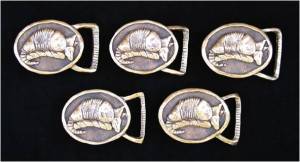
Shelley Stefan’s family heirloom belt buckles with the image of the armadillo.
But history can also be defined by the experiences of the dispossessed, who reside in the margins of the dominant, subsisting under the social radar, yet finding ways to survive, thrive and find fulfilment.
Il Museo itself is divided into two parts to represent Stefan’s dispossessed. First, the medieval part of the gallery, focusing on heraldry and the achievement of arms of the Stefan household, rectifies history’s sins of omissions regarding queer history and same-sex families. Second, the other half of the gallery demonstrates how queer culture has thrived and has been able to celebrate itself despite the necessity of concealment and subversion.
The medieval arms area of the gallery evokes medieval knights, battle armour and family arms—the world of the fortress or castle where the military triumphs, medieval banquets and family identity become one and the same. Here also medieval knights embarked on dangerous quests to preserve social order against threatening influences, guided by the Christian virtues of the court and kingdom. Their function was to save their kingdom from the seven deadly sins: lust, gluttony, greed, sloth, wrath, envy, pride.
Stefan’s female warriors, or effigies, are destroyers of an alternate set of vices that threaten to destabilize the harmony of her kingdom. In Stefan’s estimation there are six, not seven, vices: despotism, greed, malevolence, infantile behaviour, monoheroism and entitlement. According to Stefan, the true vices corrupting humanity are acts of injustice against our fellow human beings.
In Stefan’s view a courtly society must devote itself first to harmony between ourselves, our world and the rights of our neighbours. To achieve this we must first cultivate respect for others within our own homes. It is home and family that must stalwartly preserve these core values.
Stefan imparts these values in the motto she imprints on her family crest: Perfect love, Perfect trust. She chooses the armadillo as a personal emblem to connote that, for all families, especially non-traditional ones, this state of harmony requires an unusually thick skin, an armour to protect against the dissenting opinions of those who carelessly hurl insults, leaving the family unit under siege.
The second part of the gallery conveys the secret history of queer life. On the picture walls of the gallery hang Stefan’s Masked series. This portion of the gallery depicts masked revelers, an iconographic reference to Venetian culture in Baroque Italy. In Venice masks enabled men and women to walk through the streets and conduct business in public without revealing their identity. As well, masks alluded to the subversion of the social order, especially during the celebrations of the carnival. A prince could assume the persona of a pauper and the pauper could dress in the guise of a king. Through the mask, the social order and established roles could be reversed.
For Shelley Stefan the mask conceals both her personal identity but also that of her family. While she celebrates with her family in a carnival-like atmosphere, she is also protecting their identity. Her revels must be contained within the safe walls of the castle.
The walls protect her family from the outside forces that can threaten the survival of her family in the guise of non-acceptance.
The final series in the Family Lines exhibition is the ephemeral and elusive Figurations. Depicted in black and white, the Figurations are an exact embodiment of chiaroscuro, shaded enough to be hidden, but light enough to be exposed for those who care to look.
The Figurations are emblematic of the hidden history of queer life, fundamentally obscured from plain sight but able to be found by those who know what to look for.
Il Museo, the Italian Cultural Centre Museum, is open Tuesday to Saturday 10 to 6 pm.
Copyright (c) 2016 Renfrew-Collingwood Community News

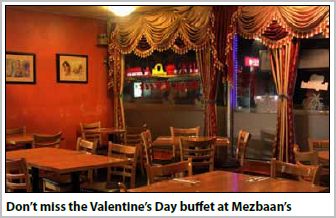 Firstly, Mezbaan. Why? Because they were smart enough to advertise with the RCC News. Secondly, because my man, Chef TJ, does have a nice, cozy romantic place whether Valentine’s or not. And, Mezbaan has been called by at least one handsome local food critic – The best buffet in town! I agree.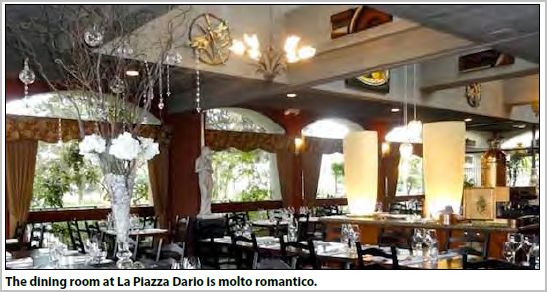

 Renfrew-Collingwood Community News